
The radiators in a New York apartment come on in late October and stay on until spring, and the air in the room changes with them. The paint feels fine, the heat is free with the rent, and you wake up with a dry nose, cracked lips and a small static shock from the light switch. So the humidifier comes out of the closet, gets filled at the kitchen tap and is put on the nightstand, and for a few weeks the room feels better.
Then it gets forgotten. The tank sits half full for days, a thin film forms on the inside, and the machine keeps sending mist into a bedroom where someone is sleeping with the window shut. This is the part nobody mentions when they hand you the box: a humidifier is a small reservoir of standing water that is warm, dark and rarely emptied, and that is the kind of place bacteria and mold like. Mayo Clinic puts it plainly: mold or bacteria can grow in dirty humidifiers, and the mist can carry them into the room.
This guide covers what the U.S. Environmental Protection Agency and Mayo Clinic say about using a humidifier safely, a cleaning routine that fits a small apartment, which water to put in the tank, what white dust on the furniture means and how to stop it, and how to store the machine when the heating season ends. It also covers the other half of the problem, which is humidity that climbs too high rather than too low.
Why a Humidifier Needs More Care Than Most Appliances
Most appliances get dirty on the outside. A humidifier gets dirty where you cannot easily see, and it releases what it holds. The EPA’s fact sheet notes that several studies have shown ultrasonic and impeller humidifiers, the two types that make a cool mist, can disperse microorganisms and minerals from their water tanks into indoor air. It adds that microorganisms often grow in humidifiers with tanks of standing water, and it states that the health effects of home humidifiers are not fully understood.
Mayo Clinic gives the same direction from a clinical side: if you or your child has asthma or allergies, talk to a healthcare professional before using a humidifier, because mist from a dirty machine may contain bacteria or mold that triggers or worsens symptoms.
None of this means you should avoid humidifiers. The moisture they add does relieve dry nose, throat, lips and skin, and the EPA notes it can ease some of the nuisances of winter heating, such as static electricity and cracks in paint and furniture. It means the machine is only as good as its last cleaning.
The four types, and which ones are riskier
Not every humidifier works the same way, and the difference matters for how careful you need to be. The EPA describes four portable types.
Ultrasonic humidifiers make a cool mist with sound vibrations. Impeller humidifiers, also called cool mist, use a rotating disk. The EPA says these two types generally produce the greatest dispersion of both microorganisms and minerals. Evaporative humidifiers blow air through a moistened wick, belt or filter. Steam vaporizers heat water to make steam. Both of those can still allow microorganisms to grow if they have a tank with standing water, but the EPA says they generally disperse less, and are not expected to disperse substantial amounts of minerals. Mayo Clinic agrees that evaporators and steam vaporizers may be less likely to release airborne allergens than cool mist machines.
If you are not sure which type you own, the model name or the manual will say. The cleaning steps below apply to all of them, and the more mist the machine throws, the more strictly you should keep to the schedule.
The Routine, in Order of Frequency
The EPA and Mayo Clinic give the same rhythm, and it is easier to follow than it looks: something small every day, something proper every third day, and a reset at the beginning and end of the season.
Every day
Unplug the machine first. Then empty the tank, wipe the inside surfaces dry and refill it with clean water. The EPA recommends this daily for portable humidifiers to reduce the growth of microorganisms, and Mayo Clinic says to do it every day if you can, adding that these steps are especially important if you use a cool mist or ultrasonic model.
In practice this takes about two minutes, and it is the single habit that does the most. Do it when you do something else you do every morning, such as filling the kettle or starting the coffee. If you cannot manage it every day, the next best thing is never to top up old water with new. Topping up leaves the old film in the tank and feeds it.
Every third day
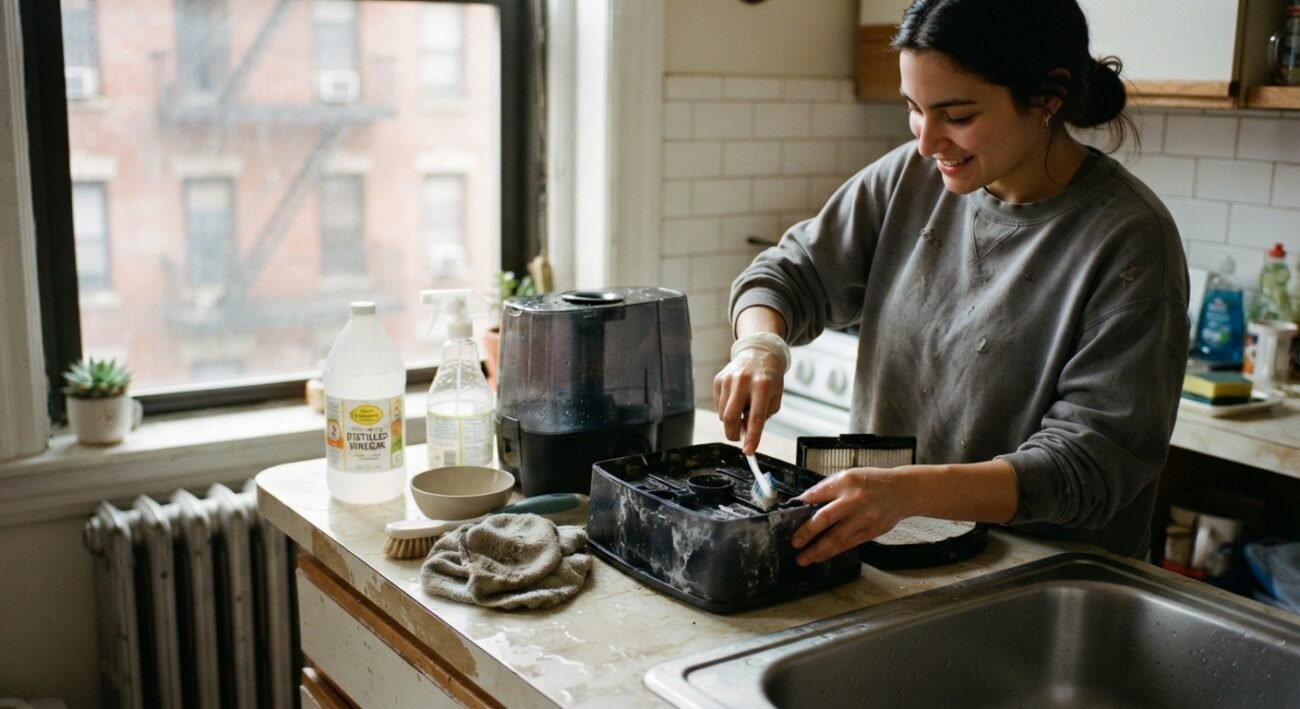
The EPA and Mayo Clinic both say to clean portable humidifiers every third day. Unplug the unit, empty the tank, and use a brush or other scrubber to remove any scale, deposits or film on the sides of the tank and on the interior surfaces. Then wipe everything dry.
For disinfecting, both organizations point first to the manufacturer. The EPA says to follow the maker’s suggestions on cleaning products and disinfectants, and that in the absence of specific recommendations you can clean all surfaces that touch water with a 3% solution of hydrogen peroxide, which is the strength sold at a pharmacy. Mayo Clinic gives the same guidance and adds that some makers suggest chlorine bleach or other disinfectants. Its advice is also not to add anything to the water in the tank and not to use disinfectants that are not approved.
Then rinse. The EPA says to rinse the tank thoroughly with several changes of tap water after using any cleaning or disinfecting agent, so the chemical is not dispersed into the air when the machine runs. Mayo Clinic repeats the point: harmful chemicals that become airborne can be breathed in.
Removing scale with vinegar
Scale is the hard, white or tan crust that builds up around the base and the heating element or in the corners of the tank. The EPA says to remove it with a brush or scrubber, and the soak that most guides suggest for stubborn deposits is white vinegar. Digital Trends, for example, describes filling the base and tank with white vinegar, leaving it for 30 minutes to an hour, then pouring it out and scrubbing remaining grime with a soft toothbrush. It then calls for a vinegar and water cloth on the exterior and remaining parts, followed by thorough rinsing with warm water, several times if needed, until the vinegar smell is gone, and air drying.
Treat that as a general approach and check your manual before you do it, since makers differ on what their parts can take. Only take apart what your model is designed to come apart, and do not force the tank from the base.
A safety note that applies to every bottle in the cabinet: never mix bleach with vinegar or with any other cleaner. Use one product at a time, rinse completely between products, and keep the window open while you work.
Filters and cartridges
If your humidifier has a filter, wick or demineralization cartridge, replace it as often as the maker suggests, and sooner if it looks dirty. Mayo Clinic says the same, and the EPA tells you to dispose of used cartridges, cassettes and filters at the end of the season rather than carrying them into the next one.
How often for a machine that runs all day
The exact interval depends on how heavily you use it. Digital Trends suggests a weekly deep clean for a machine in use all day every day, or monthly for one used sporadically during dry spells. That is more relaxed than the EPA and Mayo Clinic’s every three days, and a sensible way to read the difference is that every three days is the safe schedule for a bedroom machine that runs all night, and the longer intervals are what some people settle for. If you have asthma or allergies, or a small child in the room, keep to the shorter one.
Which Water to Use
The water question matters as much as the cleaning schedule, because the minerals in the water are what leave scale behind and what come out as white dust.
The EPA says that ultrasonic and impeller humidifiers are very efficient at dispersing the minerals in tap water into the air, and that some people are bothered by a white dust that appears on surfaces. It adds that minerals in tap water can increase crusty deposits, or scale, in humidifiers, and that scale can be a breeding ground for microorganisms. Retarding scale is, in its words, the most compelling reason to find an alternative to tap water.
Its recommendation is bottled water labeled distilled. Distilled water still contains some minerals, but it is likely to contain fewer than most tap water, and distillation is the most effective way to remove them. The EPA also warns that bottled waters labeled spring, artesian or mineral have not been treated to remove minerals, so they do not solve the problem. Mayo Clinic gives the same advice, to use distilled or demineralized water, along with demineralization cartridges or filters if the maker suggests them.
New York’s tap water is known as soft, which means it carries fewer dissolved minerals than water in many other cities. That helps explain why scale in a New York kettle builds slowly. It does not make the water mineral-free, and neither the EPA nor Mayo Clinic makes an exception for soft water. Our guide to hard water stains in NYC apartments explains why a soft-water city still gets mineral deposits, and the same reasoning applies to a tank that sits warm for weeks. If you notice white dust on the nightstand or a film forming faster than you expect, switch to distilled water before you change anything else.
Cartridges and filters can help, but the EPA notes that how well they remove minerals varies widely, and that more research is needed on how well and for how long they work. It suggests watching for white dust, which would indicate that minerals are not being removed. In a one-bedroom, a gallon of distilled water at a time is easy to carry and to keep under the sink.
Humidity: Not Too Little, Not Too Much
A humidifier solves one problem and can create another. The target range is the same from every source we read: Mayo Clinic says it is ideal to keep the humidity in your home between 30 and 50 percent, and the EPA says not to humidify to indoor relative humidity above 50 percent, because higher levels may encourage the growth of biological organisms in the home, including dust mites and molds.
The way to know where you are is a hygrometer, a small device that looks like a thermometer and measures moisture in the air. Both the EPA and Mayo Clinic suggest one, and they are sold in hardware stores. Mayo Clinic also suggests buying a humidifier with a built-in humidistat, which keeps the humidity within a healthy range for you.
Signs that you are overdoing it are visible. Mayo Clinic describes condensation, which is water vapor turning into droplets on walls, floors and other surfaces, as a sign of high humidity that can lead to the growth of bacteria, dust mites and mold. The EPA gives specific instructions: if water condenses on windows, walls or pictures, relocate the humidifier, lower its humidistat setting or reduce its use. It also says not to let the area around the machine become damp, and not to let carpeting, drapes or tablecloths near it get wet. If dampness occurs, turn the output down, or run it intermittently.
This is easy to get wrong in a small New York bedroom. A humidifier placed next to a wall can keep one spot damp while the rest of the room stays dry, and a window that fogs by morning is the signal to turn the machine down. Our guide to mold and mildew in NYC apartments covers what to look for if you notice dark spots around a window frame or in a corner, and our guide to fall and winter cleaning for NYC apartments covers the rest of the heating-season checklist.
White Dust: What It Is and How to Clean It
White dust is a fine, chalky powder that collects on the table next to the humidifier, on the dresser, on dark electronics and on window sills. It is mineral residue. The EPA says it appears with ultrasonic and impeller humidifiers when tap water is used, and Mayo Clinic says these minerals often look like white dust on your furniture and that you may also breathe in some of them.
The fix is at the source, which means distilled water. Cleaning the dust once without changing the water only gets you a week of peace. When it does settle, a damp microfiber cloth lifts it from wood, glass and plastic, and a dry cloth after that prevents streaks. On dark screens and electronics, use a barely damp, lint-free cloth and keep moisture away from vents and ports.
If the dust keeps returning even after you have switched to distilled water, the EPA suggests treating that as a sign that the filter or cartridge is not working, and replacing it.
Preparing the Machine for Storage and for the Next Season
When the heat goes off in spring, the humidifier goes back into a closet. This is where many machines are ruined. The EPA’s advice is to clean the humidifier at the end of the season, or when it will not be in frequent use, make sure all the parts are dry before it goes into storage, dispose of used cartridges, cassettes and filters, and store the unit in a dry location. After storage, clean it again and remove any dust from the outside. Mayo Clinic gives the same steps.
In a small apartment, the temptation is to put the machine away with a little water in the tank because it is easier to carry. Do not. Dry it fully, leave the cap off, and store it where the air is not damp, which in many apartments means not under the bathroom sink.
Mayo Clinic also says to consider replacing old humidifiers, because over time they can build up material that is hard or impossible to remove, and that buildup makes bacteria more likely to grow. Digital Trends suggests replacing a humidifier every three to five years, which is a reasonable guide for a machine that runs every winter.
When Something Seems Wrong
Stop using the humidifier and contact your doctor if you have respiratory symptoms that you believe are linked to periods of using it, even if you are following the maintenance instructions. That is direct advice from the EPA, and it is the one point in this guide that should override every other.
A musty or sour smell from the mist, pink, black or slimy deposits in the tank, or a tank that looks cloudy a day after you cleaned it all suggest that something has grown in it. Empty it, clean and disinfect it following the manufacturer’s directions or the 3% hydrogen peroxide method, rinse it thoroughly, and if the problem returns, replace the unit.
If you see dark spots on the wall or window frame near the humidifier, that is a moisture problem in the room, not a problem with the machine. Reduce the output, move it away from the wall, and check the humidity with a hygrometer.
What a Cleaner Can and Cannot Do
The humidifier routine is tied to the machine, not to the apartment, and it has to happen every few days. That puts it outside what a periodic cleaning visit can cover. Nobody can empty and dry your tank on the days they are not there, and the daily rinse takes less time than describing it.
What a visit can help with is everything around it. White dust and moisture end up on nightstands, shelves and window sills, and on the frames where condensation collects. Our standard cleaning covers vacuuming and mopping the floors and wiping surfaces, which is where mineral dust and spills settle. If a room has been damp for a while, or you are not sure whether the dark patches near a window are dirt or something worse, say so when you book, so the crew knows what to look at and can tell you if it needs more than cleaning.
The routine that protects your lungs and your furniture is short. Fill with distilled water, empty and dry the tank daily, scrub it every third day, rinse well after any cleaner, keep the room between 30 and 50 percent humidity, and dry the machine fully before it goes away for the summer.