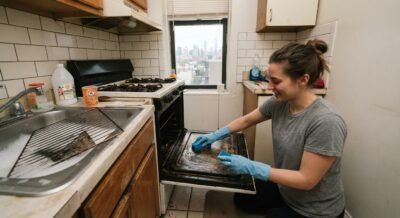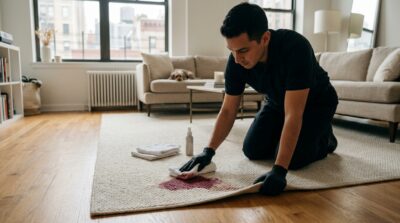
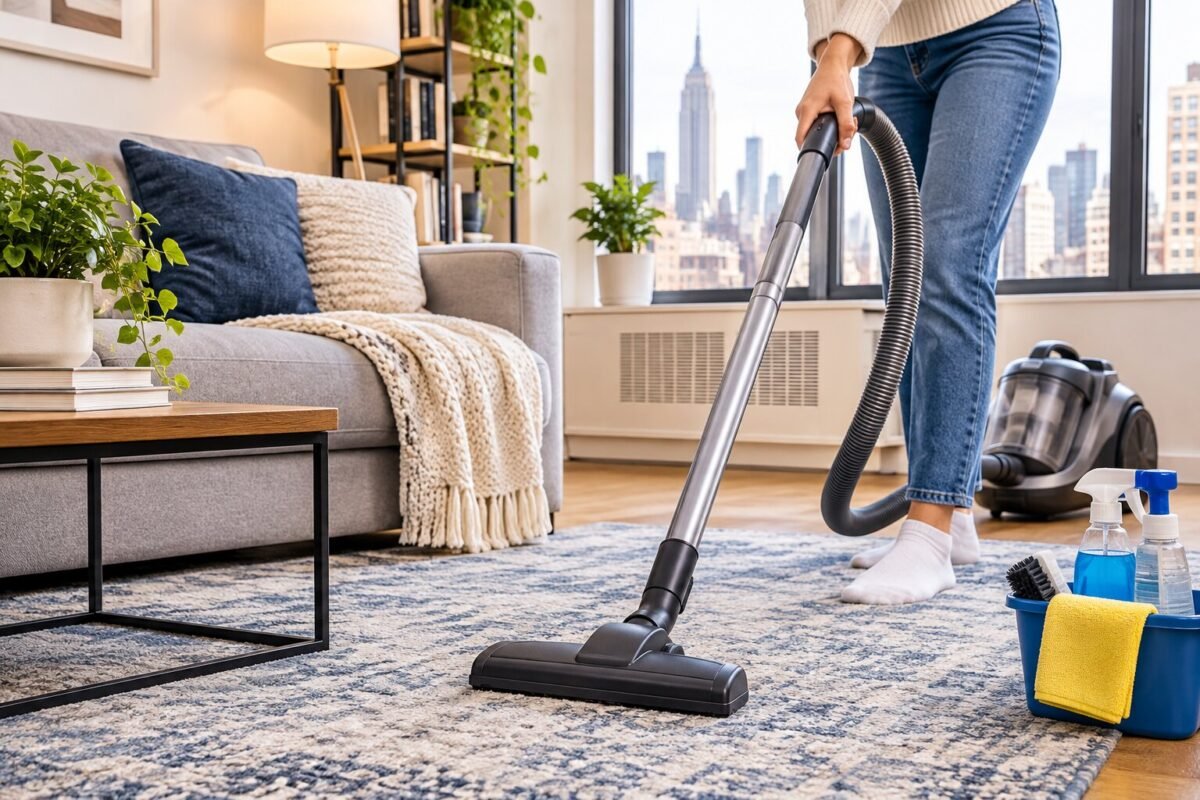
Many New York apartments have little or no wall-to-wall carpet. What they have is a rug: a large one under the sofa, a runner in the hallway, a small one by the bed. Some apartments do have fitted carpet, often in a bedroom, and that carpet may have been there through several tenants before you. Either way, the floor covering you walk on every day holds more dirt than the surface suggests, and most people clean it by vacuuming when they remember and by panic when something spills.
This guide covers what the Carpet and Rug Institute (CRI) recommends for everyday care, how to vacuum so the machine does some real work, how to deep clean at home with a hot water extractor and what the rental really involves, how to handle area rugs of different types, what changes with pets, and when it makes more sense to hand the job to a professional. Stain removal has its own guide, so here we focus on routine and deep cleaning.
The Four-Step Approach From the Carpet Industry
CRI, the trade body that tests carpet cleaning products and machines, boils home carpet care down to four things. Vacuum regularly. Clean spots quickly. Have the carpet professionally deep cleaned every 12 to 18 months. And keep dirt from getting in at the door in the first place.
The last one deserves more attention than it gets. CRI’s advice is to put mats outside and inside every entrance, take shoes off at the door, and change the air filters, all of which reduce what reaches the carpet. In a New York apartment this is easy to do and cheap, because there is usually one door. A doormat inside, a tray for shoes, and a quick wipe of the soles of anything that came off the street is a better investment than any machine.
The 12 to 18 month interval is also a practical benchmark for renters who plan to move. CRI notes that some carpet warranties require professional cleaning, and a carpet that has a cleaning record is easier to defend at move-out. If you are not sure where your lease stands on carpet, our move-out cleaning checklist covers what a landlord looks at.
How to Vacuum a Carpet Properly
Vacuuming is the cleaning that matters most, because it takes out the dry soil that grinds into fibers and makes carpet look dull. CRI says to vacuum at least once a week, and more in rooms with a lot of foot traffic. A small studio does not have much traffic in the usual sense, but the path between the door, the kitchen and the bed behaves like a traffic lane, and that strip needs more passes than the corner behind the dresser.
CRI’s advice on technique is that slow and steady beats fast. Move the vacuum slowly so it has time to lift soil out of the pile, and take care in corners and crevices, which are where dust collects. Empty the canister or replace the bag when it is somewhere between half and two thirds full, since a full bag loses suction. CRI also suggests using a vacuum that carries its Seal of Approval, which is the same testing program that certifies cleaning machines and solutions.
A few habits make the job easier in a small apartment. Move light furniture instead of vacuuming around it, at least once a month. Pick up anything on the floor first, because small objects jam a vacuum, and Bob Vila makes the same point about rubber bands, hair accessories and paper clips jamming an extractor. Check the manual for your machine and your carpet. Different carpet constructions respond differently to a spinning brush, and the vacuum’s manual and the carpet’s care information are the authority on what settings to use.
Rugs and runners
For a loose area rug, CRI says to vacuum it the same way but use extra care on fringe: use gentle suction, work from the center toward the fringe, and lift the edge of the rug rather than running the vacuum over the fringe. Vacuum the back of a rug now and then too, since dirt that sifts down builds up on the floor underneath. This matters on hardwood, where grit under a rug scratches the floor surface.
Cleaning Spots Before They Become Stains
CRI’s guidance on spots is short and worth following. Blot with a white cloth, working from the outside of the spill toward the middle, and do not scrub or brush, since that pushes the spill deeper and can fray the fibers. Pretest any cleaner on a hidden spot, remember that more product is not better, and blot with clear water afterward so no residue is left behind to attract dirt. Our guide to getting stains out of carpets and rugs goes through specific stains one by one.
Deep Cleaning at Home: What a Hot Water Extractor Does
Vacuuming does not take out sticky residue, body oil or the film that tracked-in grime leaves, which is why CRI recommends a periodic deep clean. If you want to do that yourself, the machine to use is a hot water extractor. Bob Vila’s guide on shampooing carpets calls these the gold standard among machines available to homeowners, ahead of shampooing machines and buffers with moistened pads, and says that shampooing once a year, or more often for stained or heavily soiled synthetic carpet, can keep carpets looking and smelling good.
Hot water extraction is not the same as steam cleaning
The two names are used interchangeably, but they are different methods. Bob Vila explains that a steam cleaner uses steam along with shampoo and is more widely recommended for hard surfaces, because critics say steam can worsen stains and damage carpet fibers. Hot water extraction forces a mixture of hot, but not steaming, water and carpet shampoo into the carpet, then pulls the solution and the dirt back out. When you rent or hire, ask which method is being used, because a handheld “steam” appliance and a proper extractor are not the same tool.
The process, step by step
Bob Vila’s process is straightforward, and the details matter more than the order.
First, choose a CRI-approved machine, which is labeled bronze, silver or gold, and use only a commercial carpet shampoo with the CRI seal that is compatible with your machine. Do not add any other chemicals or under-dilute the solution to make it stronger. Second, clear the room so as much carpet as possible is exposed, and treat small tough stains with a stain remover first. Third, vacuum the whole area before you begin, which removes loose dirt and gravel and fluffs the fibers so the cleaning works better.
Fourth, fill the machine with the exact amount of water and shampoo it specifies. Too much shampoo is a common mistake: Bob Vila says it will not dissolve well and will leave a residue that acts as a dirt magnet. Test the solution in an inconspicuous corner first. Start in a far corner and move slowly, pressing the release button intermittently so you do not flood the carpet, because excess water raises drying time and can lead to mold. Keep going until the water the machine extracts runs clear.
One detail on water temperature: Bob Vila says not to use hot water on natural materials since it will shrink and damage the fibers. For wool carpet, use cold water, and use hot water with synthetic carpet only.
Drying, and why it takes longer in an apartment
Bob Vila gives four to six hours as a rule of thumb for an average room with good ventilation, with some carpets taking anywhere from 8 to 24 hours to dry fully. It also warns that wood furniture standing on wet carpet can release dye from its stain onto the fibers and leave lasting marks, so keep wooden furniture off the carpet until it is completely dry. When the carpet is completely dry, vacuum again to remove any leftover residue.
In a New York apartment, the drying is the real constraint. Windows are often small or painted shut, there may be no central air to move the air, and the machine has to share the apartment with you. Plan the cleaning for a day when you can open windows, run a fan, and keep the room clear of foot traffic and furniture. Shoes on damp carpet will track dirt straight back in.
What a rental really involves
Bob Vila notes that renting an extractor from Home Depot in the New York City area cost about $79 per day, though it varies. Add the shampoo, the time to move furniture and carry a heavy machine up the stairs or the elevator, and the noise, since Bob Vila recommends hearing protection and warns that the machines are heavy and loud. For one room, it is a reasonable weekend project. For a whole apartment, it is a bigger job than it looks.
Area Rugs by Type
The care of a rug depends on how it is made, and the label comes first. CRI’s guidance on rugs breaks down as follows.
Small washable rugs can go in the washing machine in warm water, 90 to 105 degrees, with mild detergent, and be tumble dried on the lowest heat. Large rugs should be shaken or beaten outdoors, then vacuumed, which is hard to do in an apartment unless the building has a yard or roof you can use. If the label says dry clean, call the cleaner first to confirm they handle rugs. Fringe gets gentle suction. For Oriental, Turkish and Persian rugs, follow the manufacturer’s directions or use professionals, and for heirloom rugs CRI says to let professionals handle the cleaning.
That last category is where most expensive mistakes happen. A hand-knotted rug can bleed dye, shrink or lose its shape if it is treated like a bath mat. If you are not sure what you have, do not experiment with a rented extractor. Vacuum it regularly, blot spills, and ask a professional to look at it before anything wet touches it.
Pets Change the Rules
CRI says to vacuum more often if you have pets, and gives one important warning about urine: do not use a steam cleaner on pet urine spots, because the heat can set both the stain and the smell. Instead, extract the spot with a wet vacuum, rinse with cool water, and use pet-specific products that carry the CRI Seal of Approval. Professional cleaning every 12 to 18 months applies here as well.
If pet hair is the main problem, our guide to pet hair removal in NYC apartments goes through the tools that work, and our guide to keeping your home clean with pets covers the routine.
Choosing a Shampoo, and the Dry Option
Not every carpet cleaning product is meant for every machine, and the wrong one costs you either cleaning power or a sticky carpet. Bob Vila describes three main types. Dry carpet shampoo is a powder: you sprinkle it on, brush it in to activate the particles that lift dirt and smells, and then vacuum it up. It says dry shampoo can be as effective as liquid shampoo for odors and tough organic stains. Traditional liquid shampoo performs best with an extractor or other carpet cleaning machine and, when diluted properly, is typically a low-foaming formula. The third group is products tested by CRI, which checks soil removal, resoiling, residual moisture, surface appearance change, colorfastness and pH.
Read the label before buying. A product meant for carpet should list the fabrics it is designed for, and the machine brands it works with. If the label does not say, choose something else. For a small apartment where a wet clean is hard to dry, the dry method is worth considering for a refresh between deeper cleans, as long as the label supports it for your carpet.
A Realistic Schedule for an Apartment
Putting the sources together, a routine that suits a one- or two-bedroom looks like this.
| Task | How often | Source |
| Vacuum carpet and rugs | At least weekly, more in high-traffic areas | CRI |
| Vacuum under and behind rugs, and the rug back | Monthly is a sensible habit | Our suggestion |
| Blot spills | Right away | CRI |
| Empty the canister or change the bag | When half to two thirds full | CRI |
| Wash small washable rugs | When they look or smell dirty, per the label | CRI |
| Deep clean wall-to-wall carpet | Every 12 to 18 months, professionally | CRI |
| Hot water extraction at home | About once a year, more for heavy soiling | Bob Vila |
| Change the HVAC or air filter | Per the maker, to keep dust down | CRI |
Pet owners should shift everything toward the shorter end. If you move every couple of years, line the deep clean up with the move rather than adding it as a separate chore.
Setting Up the Room So the Clean Actually Works
Most of the effort in a deep clean is preparation, and in a small room it matters more because there is nowhere to put things. Clear what you can into another room, or stack it on a bed or in the hallway, so that as much carpet as possible is exposed. Use the vacuum first, as above. Treat tough spots before the machine goes over them, so the extractor does not just spread them around.
Then think about where you will be while it dries. If the bedroom carpet is wet for a day, you need somewhere else to sleep, or the clean should happen early in the day with windows open and a fan running. Bob Vila’s 4 to 6 hour rule is for good ventilation, so the plan should create ventilation rather than hope for it. When the room is dry, put the furniture back, vacuum one more time to pick up residue, and keep shoes at the door.
What a Carpet Tells You About the Rest of the Apartment
A carpet that gets dirty in the same place again and again is giving you information. A dark path from the door to the couch means shoes are coming in. A stain that returns after cleaning usually means there is residue in the carpet or a spill that soaked into the pad underneath, which is one of the reasons CRI warns against using more product than the label says. These patterns are worth noticing because fixing the cause is cheaper than cleaning the symptom twice a year.
What Not to Do
A short list from the sources, since these mistakes are common:
Scrubbing a spill instead of blotting. Using more shampoo than the label says. Putting hot water on a wool carpet. Flooding the carpet so it takes a day to dry. Putting furniture back on damp carpet. Using a steam cleaner on pet urine. Skipping the mats at the door. And treating a valuable rug like any other floor covering.
When to Call a Professional
Doing it yourself works for a room, on a synthetic carpet, with time to let it dry. A professional makes sense in several situations that come up often in New York: a whole apartment of carpet, a bedroom carpet at the end of a lease, an area rug you cannot wash or move easily, an older stain or odor, and any rug that matters to you.
Our carpet and couch cleaning service covers area rug deep cleaning and carpet and upholstery cleaning, with stain pre-treatment, odor neutralization, and allergen and dust mite removal. The crew uses commercial air movers to speed drying, which is the part that is hardest to manage in an apartment without central air. The service page also notes that hot water extraction rinses the fibers, while plain shampooing can leave soap residue behind, which lines up with the residue warning from Bob Vila above.
When you book, tell the crew what the rug or carpet is made of if you know, whether there are pets, and where the problem spots are. That lets them choose the method, and it is the same information you would need to decide on a DIY approach.
For everyday care, the plan is simple: mats at the door, a weekly vacuum with extra passes on the traffic lane, spots blotted right away, and a deep clean every 12 to 18 months, by you with a proper extractor or by a professional.
Skip the Cleaning. Keep the Weekend.
Book your cleaning in 60 seconds — we handle the rest.
Book Now