
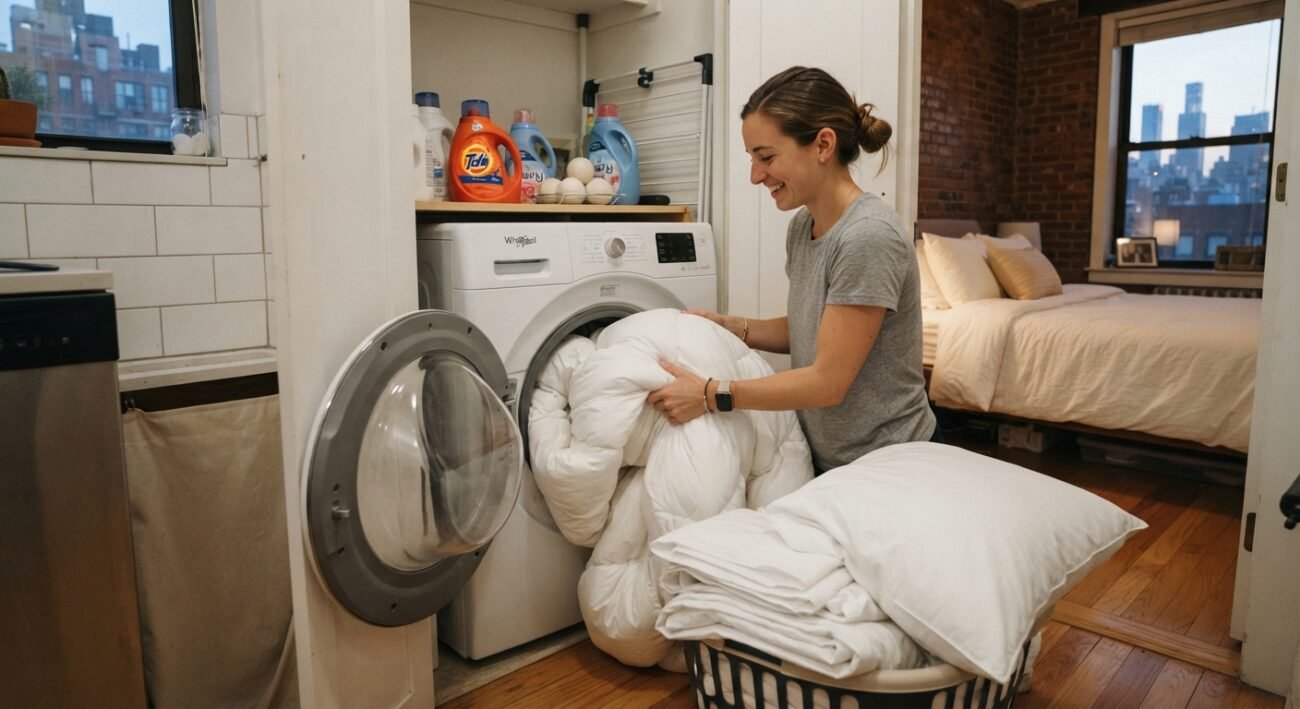
Most people have a rough routine for sheets and none at all for the things underneath them. The pillow you sleep on every night, the comforter you pull up in January and the mattress under it all collect sweat, skin cells and dust for years, and in a typical New York apartment there is one more obstacle: the washing machine is in the basement, down the block, or not in the picture at all.
This guide covers how often each piece of bedding should be washed, how to wash a pillow by what it is filled with, how to handle a comforter that does not fit your machine, what to do with the mattress, and how to get it all done when your laundry day involves a laundromat. The schedules come from Cleveland Clinic, AAA Club Alliance, Reviewed and Homes & Gardens, which do not agree on every number, so where they differ we give the range and explain how to pick.
Why Bedding Gets Dirty Faster Than You Think
You spend a third of your life in bed, and the bed absorbs a lot of it. Cleveland Clinic’s guidance on bedding names the usual contributors: sweat, body oils, dead skin, pets that sleep on the bed, and crumbs from eating in it. Heat and humidity make everything worse, and so do asthma and allergies. AAA’s bedding guide points out that sheets, mattresses and pillows are cozy nests for dust mites, microscopic bugs that feed on dead skin cells and are among the most common causes of allergy symptoms such as sneezing, coughing and a runny nose.
You do not need to see anything to know it is time. Cleveland Clinic lists the signs that bedding should be washed now, whatever the calendar says: an odor, visible stains, a grimy feel, or crumbs. If you have been sick, wash everything that touched you. If you notice that you sneeze or wake up congested most mornings, Reviewed suggests that is one of the signs a pillow is due for replacement, not just a wash.
How Often to Wash What
The schedule below combines what the sources recommend. Sheets and pillowcases are the one place where everyone agrees. For the rest, the figures are ranges because the advice depends on who sleeps in the bed.
| Item | How often | Source |
| Sheets and pillowcases | Weekly | Cleveland Clinic, AAA |
| Sheets with a pet in the bed | Every 3 to 4 days | AAA, citing the Sleep Foundation |
| Pillow protectors | Every 2 to 4 weeks, or at least every 3 months | Homes & Gardens, AAA |
| Duvet cover | Every 2 weeks to a month | AAA |
| Pillows | Every 3 to 6 months | AAA, Homes & Gardens |
| Pillows with allergies or asthma | About every 2 months | Homes & Gardens |
| Feather pillows | Once or twice a year | Homes & Gardens |
| Comforter | Every 2 to 3 months, or every 6 months | AAA, Cleveland Clinic |
| Throw pillows | At least once a quarter | Homes & Gardens |
| Mattress | About every 6 months (vacuum and spot clean) | Cleveland Clinic |
A few notes on reading this table. Cleveland Clinic and Reviewed both put pillows and comforters at roughly every six months, while AAA and Homes & Gardens give three to six, so the longer interval is for a bed with one adult, no pets and no allergies. If you sweat at night, sleep with the heat up, share the bed with a dog, or have allergies, pick the short end. The same logic applies to sheets: AAA says to wash more often in summer, up to twice a week, because people sweat more in warm months. An apartment with radiator heat that you cannot turn down does the same thing in January.
If you are trying to fit all of this into a household rhythm, our guide to how often to clean every room in an NYC apartment puts bedding next to the rest of the chores, and our allergen guide for NYC apartments covers the bedroom if dust mites are the reason you are here.
Pillows: Check the Fill Before You Wash
Washing a pillow the wrong way is how you end up with a lumpy, waterlogged one that smells worse than before. The first step is always the care label. Homes & Gardens quotes a Sit ‘n Sleep executive saying to check the manufacturer’s instructions before washing a pillow, since most can go in the machine but some need dry cleaning. As a general rule, the same source says, fiberfill, cotton, feather and down pillows can usually be machine washed, while latex and memory foam cannot.
Fiberfill, cotton and other machine-washable pillows
Reviewed’s method is simple. Remove the pillowcase and any protector, put the pillows in the washer, and add a small amount of detergent. Use warm water on the gentle cycle unless the label says otherwise. In a top-loading machine, wash at least two pillows at once, because a single wet pillow throws the drum off balance. Homes & Gardens repeats the two-pillow advice and adds two details that make a real difference: run a second rinse if your machine has one, and if the pillows are still heavy with water after the spin, spin them again. The aim is damp, not dripping.
Skip the fabric softener. Homes & Gardens says never to use it on feather pillows, and AAA warns that softener and dryer sheets can leave a waxy coating on linens that traps dust and dirt. Reviewed also mentions that the maker of one common shredded-foam pillow recommends skipping bleach as well, and closing the zipper with a safety pin so the filling stays inside.
Feather and down
Feather pillows can usually be machine washed, with a gentle cycle and a small amount of neutral detergent. They also need it less often: Homes & Gardens says once or twice a year is enough, to protect the natural fill. If you would rather not put them through a machine, a hand wash is an option, but the same source says it is the cover that should be washed, not the feathers. Lightly sponge a mild detergent solution onto the cover, then sponge with clean cool water to remove the soap, and avoid saturating the fill. Reviewed notes that one down pillow it tested is spot-clean only, or a trip to the dry cleaner, which is another reason to read the tag first.
Memory foam and latex
These do not go in a washing machine. Reviewed describes the process as similar to cleaning a memory foam mattress: take the pillow out of its case, use a handheld vacuum to remove dust and debris, treat stains with a lint-free cloth and a gentle cleaning agent such as baking soda or a diluted laundry soap solution, and let the pillow air dry. It has to be completely dry before it goes back on the bed, because the material traps moisture, and moisture leads to mold.
Homes & Gardens adds that if the label does not say dry clean only, you may be able to hand wash a foam pillow in a tub or large sink with a few inches of warm water and liquid detergent, squeezing gently and rinsing until the water runs clear. A quick freshening between washes is also possible: the owner of a bedding retailer quoted there suggests sprinkling baking soda over the pillow, leaving it in direct sunlight for two to three hours, and vacuuming it off thoroughly. In a small apartment the sunlight part may mean a window sill with a good south exposure, so check that it will not be rained on or blocked by the building next door.
Throw and decorative pillows
Throw pillows get ignored because they are not slept on, but they sit on a couch or the bed all day. Homes & Gardens recommends washing them at least once a quarter, more often if pets are allowed on the furniture. Many have removable covers, which is the easy way: wash the covers with the rest of your laundry and vacuum the insert. If the label says spot clean only, use a vacuum upholstery attachment and a damp cloth.
Drying Pillows Without Ruining Them
Drying is where most pillow washing goes wrong, and it is the part an apartment makes harder. Reviewed’s advice is to move the pillows to the dryer with a couple of tennis balls or dryer balls to help fluff them, tumble on low heat, and wait until they are completely dry before making the bed. AAA says to tumble pillows on low or no heat, because they can lose their shape in a dryer, and its source suggests a drain-and-spin cycle first if you need to remove excess water.
Two practical points. First, a pillow that feels dry on the outside can still be damp in the center, which is where mustiness starts, so squeeze it and smell it before you put it away. If it takes two cycles at a laundromat, that is normal. Second, do not rush it with high heat.
Comforters and Duvets
A comforter is the biggest thing most people wash, and the main problem is size. AAA says duvet covers can go in the washer every two weeks to a month, and comforters every two to three months, while Cleveland Clinic puts other bedding such as comforters and pillows at about every six months or as needed. Reading both, a duvet cover that is washed regularly is what lets you wash the comforter less often, which is the reason to use one.
Before anything goes in the drum, check the care label, because AAA notes that some comforters need dry cleaning. If it is machine washable, treat any stains first with a stain remover, use the bulky setting if your machine has one, and follow the label for temperature, which AAA says is typically cooler for a comforter. Add an extra spin to remove water, then tumble on a low or no heat setting and fluff the comforter every 30 minutes so the fill does not clump. A comforter that is still damp in the middle should go back in, not onto the bed.
Water temperature is the one place the sources seem to disagree, and it is worth understanding why. Cleveland Clinic says hot water kills dust mites, which is why hot is the default for sheets. AAA agrees that in most cases manufacturers recommend hot water for bedding, but adds that the material matters: a cotton duvet can take higher temperatures, while some polyesters need cooler water or a gentle setting. So the answer depends on what the item is made of. Whatever the label says is the limit, and the label wins over any article, including this one.
Also avoid bleach. AAA warns that it can warp the fabric threads so that sheets and pillowcases lose their texture and shape.
Sheets, Pillowcases and Protectors
Sheets are the easy part, and Cleveland Clinic’s advice here is blunt: wash them at least weekly. The weekly figure comes from dermatologist Sean McGregor, quoted in that guide. A few details are worth keeping in mind.
Use hot water when the fabric allows it, because that is what kills dust mites. Dry on low if you can, since AAA says low heat is gentler on the fabric, even though it takes longer. And do not make the bed the moment you get up. Cleveland Clinic suggests leaving it open for a while so the sheets can dry out from the moisture of the night before.
Pillow protectors are worth adding if you do not use them. AAA says to cover mattresses and pillows in protectors to deter dust mites, and to wash the protectors every three months. Homes & Gardens suggests every two to four weeks, which fits a household with allergies. The protector is the thing that takes the sweat, so washing it is much easier than washing the pillow, and it extends the time between pillow washes. Reviewed makes the same point in its pillow buying advice: a protector keeps out sweat and drool, and moisture can lead to fungus.
The Mattress Underneath
When you strip the bed for washing, look at the mattress. Cleveland Clinic recommends cleaning it about every six months: vacuum it, then spot clean with mild detergent. AAA gives a stain recipe from its sleep health source: a mixture of baking soda, hydrogen peroxide and dish soap blotted onto the stain, then vacuumed afterward to remove residue. It also suggests flipping or rotating the mattress every three to six months, depending on the type, and notes that washing the mattress protector is a good moment to do both.
Do not soak a mattress. Whatever you apply should be minimal and the mattress should dry fully before the sheets go back on. A full steam clean is a different job and is usually done by someone with an extraction machine, which is covered at the end.
Doing It All in an Apartment Without a Washer
This is where New York changes the advice. Many apartments have no machine in the unit, and a bulky comforter can be too much for a small one even when there is. The practical options are a laundromat with large-capacity machines, a wash-and-fold service that handles bulky items, or a dry cleaner for anything labeled dry clean only.
If you are going to a laundromat, plan it as one trip rather than three. A workable order is: strip the bed at home, wash sheets and pillowcases in the standard machine, then put the comforter in a large front-loader with the bulky setting while the sheets go into the dryer. Do pillows on a separate trip, or at the end, in pairs, because two pillows balance a machine and one does not. Bring your own tennis balls or dryer balls for the pillows, and a large bag for the trip home.
AAA suggests hanging bedding on a line to dry, but few apartments have the space for one. If a pillow or comforter comes out of the dryer still damp in the middle, give it another cycle at the laundromat rather than carrying it home to finish drying.
When to Replace Instead of Wash
No pillow lasts forever. Reviewed says sleep experts suggest replacing a pillow every few years, and offers a short test: Did you buy it more than two years ago? Does your head or neck feel unsupported? Do you wake up sneezing or congested every day? Is it lumpy or losing its shape? Do you have to fluff it for support? If you fold the pillow in half, does it stay folded? Several yes answers mean a new pillow will do more than another wash.
The same logic applies to anything with a permanent stain or odor that survives a proper wash. A comforter that smells musty after a good wash and a full dry has likely absorbed moisture somewhere in the fill, and it may be time to replace it.
Mistakes That Shorten the Life of Bedding
A handful of habits come up again and again in these sources:
Washing a single pillow and expecting the machine to cope, when it will not balance. Using fabric softener on pillows and sheets, which leaves a coating on the fabric. Using bleach on sheets and pillowcases, which can warp the threads. Putting foam in a washer or a dryer. Returning damp pillows to the bed, which invites mold. Skipping the pillow protector, which is the cheapest way to keep the pillow clean. And leaving the mattress alone for years under a clean-looking sheet.
Where a Professional Fits In
Most of this is laundry, and laundry belongs to you or a wash-and-fold. Where a cleaning company is useful is the rest of the bedroom. Our standard cleaning includes bed making, and light laundry and folding is part of what the crew can do on a visit, which helps if the routine of stripping and remaking the bed is what keeps slipping. If you share the apartment with someone and nobody wants to own the laundromat trip, putting the sheets on the schedule is a practical way to make the weekly change actually happen.
For the mattress, our carpet and couch cleaning service includes mattress steam cleaning, along with allergen and dust mite removal, which is the deeper version of the vacuum-and-spot-clean routine above. It is worth considering once or twice a year, particularly if allergies are the reason you are reading this, or after an illness, a spill or a stretch with a pet on the bed.
The routine that keeps a bed clean is short: wash sheets and pillowcases weekly, launder protectors and duvet covers on a regular rhythm, wash pillows and the comforter two to four times a year depending on who sleeps in the bed, vacuum the mattress when you change the protector, and replace pillows when they stop holding their shape.
Get Your Custom Cleaning Quote — Free
Every NYC apartment is different. Get pricing tailored to your space in minutes.
Get My Free Quote