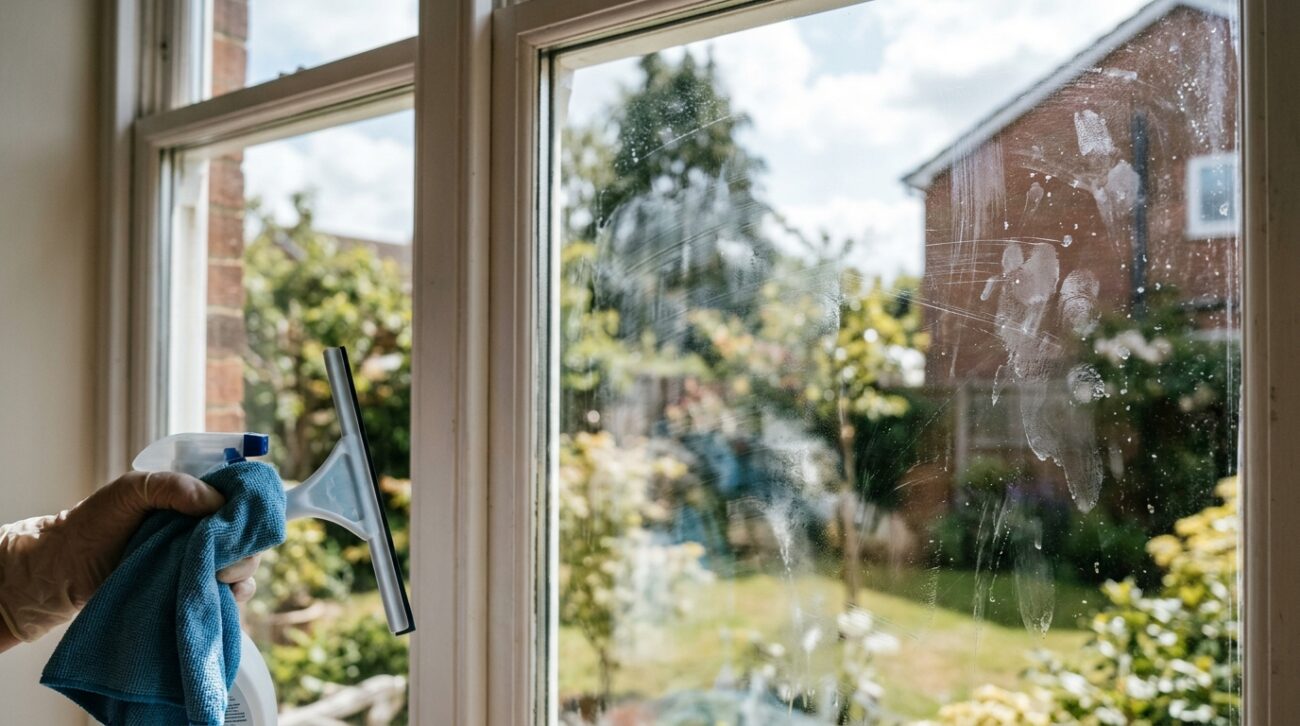
You wiped the glass. You used the good cloth. You did the corners. And then the sun came around to the window, and there it was again: haze, cloudy patches, a faint film that looks exactly like the one you just spent twenty minutes removing.
At that point most people do the logical thing. They spray more cleaner and wipe harder. Sometimes that works. A lot of the time it makes no difference at all, because the problem isn’t on the surface you’re cleaning. It’s somewhere a cloth can’t reach, or it isn’t dirt in the first place.
Glass that looks dirty after cleaning usually comes down to a handful of causes, and each one has a different fix. Some are cleaning problems. Several are window problems that no amount of wiping will touch. Telling them apart takes about five minutes and saves you from scrubbing something that was never going to come clean.
This guide is a diagnostic. It walks through what to check, in what order, what each result means, and what to do about it, with a few notes on why New York apartments develop these problems more than most.
The five-minute diagnosis
Do this on a sunny day, or at night with a flashlight held at a low angle to the glass. Low, raking light shows everything.
- Find where the haze is. Wipe a small patch on the room side with a clean, damp cloth, then dry it with a second clean cloth. Look again. If the patch is clear, the haze was on your side of the glass.
- Check the outside if you can do it safely, from a terrace, a ground-floor window, or a tilt-in window that swings open for cleaning. Wipe a patch there too. Never lean out of a window above the ground floor to do this. If you can’t reach safely, skip it.
- Look for fog between two panes. If your window is double-pane and both sides are clean but the haze remains, it may be inside the sealed unit.
- Run a fingernail across the problem. Gently drag a nail over the line or patch. If it catches, it’s likely a scratch or etching. If your nail glides over, it’s film, residue, or something inside the glass unit.
- Try the vinegar test on spots. Hold a cloth soaked in white vinegar against a spot for two or three minutes, then wipe. If the spot dissolves, it was a fresh mineral deposit. If it looks the same, the glass is probably etched.
The answers sort you into one of the categories below.
Cause 1: It’s on the outside, and you’re looking through both layers
This is the most common reason, and it’s the least dramatic. In a New York apartment, the outside of the glass collects far more grime than the inside: traffic soot, construction dust, pollen, bird droppings, and whatever rain carries down the face of the building. When the inside is spotless and the outside is dull, the window still looks dirty from your couch, because you’re looking through both surfaces at once.
The wipe test settles it. If the room side patch looked identical to the rest of the window, the dirt is outside.
What to do: reach what you can reach safely. Tilt-in windows, ground-floor windows, and windows opening onto terraces can be cleaned from the right side. For everything else, the exterior glass on an upper floor is a job for professionals with proper equipment and safety gear. We cover where the line sits in our guide to window cleaning in a NYC high-rise or walk-up. No streak justifies leaning out of a fifth-floor window.
Cause 2: A film on the inside that isn’t dust
Dust wipes off. A film doesn’t, at least not with a dry cloth or a standard glass spray. Interior film is common in apartments, and it comes from things you do rather than things the street does.
- Cooking. Kitchen windows pick up a thin layer of airborne grease. It looks like a cloud, not a smear.
- Smoke and vapor. Cigarette smoke, vaping, incense, and candles all leave oily residue.
- Aerosols and air fresheners. Sprays settle as a sticky layer, and cleaners and polishes can build up on glass over time.
- Radiator dust. In an older building, glass above a steam radiator is warm, and dust and soot that land on it get baked into a gray haze.
How to recognize it: the haze is on the room side, it’s uniform, it’s strongest near the kitchen, near the radiator, or where someone smokes, and a dry cloth just smears it.
What to do: degrease before you polish. A few drops of dish soap in warm water on a microfiber cloth cuts through oily film. Wipe, rinse the cloth, wipe again with clean water, then finish with a dry cloth or a squeegee. Only after that should you use glass cleaner, if at all. Glass cleaner on top of a grease layer is how you get streaks.
Cause 3: Streaks, which are a technique problem
Streaks are the one cause on this list where the window itself is fine. They come from a few predictable mistakes: too much product left on the glass, a cloth that’s already dirty or damp, or cleaning in hot direct sun so the solution dries before it’s wiped.
New York adds one more cause. Many pre-war windows sit above a radiator, and in winter that glass can get warm enough to dry the cleaner before you wipe it. And low light, like a west-facing window in the late afternoon, lights up every pass of the cloth.
How to recognize them: streaks follow the direction someone wiped, in arcs and lines, and they smear under a dry fingertip.
What to do: wait for a cool, overcast time of day or clean after the radiator has been off. Use less cleaner than you think you need, a clean damp cloth followed by a clean dry one (or a squeegee), and buff at the end from a low angle. The full method is in the window article linked above.
Cause 4: Fog or haze between the panes
If your windows are double-pane, which most newer buildings and many replacement windows are, you have two sheets of glass sealed together with a small gap between them. That unit is called an insulated glass unit (IGU). It’s sealed around the edge to keep moisture out. When the seal fails, humid air gets into the gap and condenses on the inside faces of the glass. You see fog, a milky haze, or water droplets that appear and disappear with the weather. Over time, minerals in the moisture can leave a permanent white film.
How to recognize it:
- Both outer surfaces are clean and smooth.
- The haze moves or changes with temperature, humidity, and time of day. It might look worse in the morning and clear up by afternoon.
- It sits in a place you can’t wipe, usually starting at the edges or corners and spreading.
What to do: there’s no cleaning fix. The inside faces of the panes are sealed off from the room and the street. The repair is replacing the sealed glass unit, or sometimes the whole window, which is cheaper than people expect for the glass unit alone. In a rental, a failed seal is a maintenance issue, so report it to your landlord or building management in writing and take a photo. Seals typically last many years, and older windows are more likely to fail.
Cause 5: Mineral deposits and etching
This is the cause that most often leaves people baffled, because the glass looks cloudy in a way nothing removes.
Water carries minerals. When it dries on glass, it leaves white spots and rings. Fresh ones come off with normal cleaning or a vinegar soak. But if they sit for months, repeated wetting and drying can slowly attack the surface and leave it permanently rough and cloudy. That’s etching. The damage is in the glass, not on it.
New York has some typical sources of the trouble:
- A window AC unit on the floor above. Condensate drips down the face of the building all summer, carrying dust and minerals onto the window below. If the window gets hit every day for months, spots become etching.
- Runoff from concrete, mortar, and limestone. Rain washing across masonry picks up alkaline compounds, and cement-based runoff is notorious for etching glass.
- Sprinklers and hoses, more common at brownstone back windows and ground-floor gardens.
- Rain and condensation on the inside, in winter, in windows that sweat.
Since the city’s tap water is actually quite soft, as we explain in our piece on hard water stains in NYC apartments, most window deposits come from the sources above, not from your faucet.
How to recognize it: white spots or a general cloudiness that doesn’t move when you wipe, doesn’t change with the weather, and feels slightly rough under a fingertip. If vinegar held on a spot for several minutes doesn’t dissolve it, the glass is etched.
What to do: for fresh spots, hold a cloth soaked in white vinegar on them for a few minutes, scrub gently with a soft cloth, rinse, and dry. For older deposits, a lime and mineral remover made for glass helps. Test it on a small spot first, and keep any acidic product off frames, sealant, and sills. For true etching, light cases can sometimes be improved with a glass polish, but heavy etching is permanent. Treat it as a window problem. And if the cause is a neighbor’s AC drip, a polite note to the building often fixes the next round before it starts.
Cause 6: Scratches
Scratches get mistaken for dirt more than anything else, because they catch the light at an angle and look like streaks that won’t wipe off.
Most scratches have the same history. Someone took paint off glass with a razor scraper or a scouring pad after a renovation, and a bit of grit dragged along under the blade. Some come from rings and keys. A few are from cleaning gritty glass with a dry cloth.
How to recognize them: thin lines that don’t change when you wipe, may look different from different angles, and catch a fingernail.
What to do: fine surface scratches can sometimes be reduced by a professional with the right polishing compounds. Deep scratches mean new glass. To avoid making more: never wipe gritty glass dry, never use steel wool or abrasive pads, and if you use a razor scraper for paint or stickers, use a new blade, keep the glass wet, and push flat, never at an angle. Check first whether your glass has a coating. Some windows carry a low-emissivity (low-e) coating that can be scratched or damaged by scrapers. In most double-pane windows that coating is protected inside the sealed unit, but if you’re unsure, check with the manufacturer or building management before scraping anything.
Cause 7: The frame is shedding onto the glass
Sometimes the glass is fine and the frame is the problem. Old aluminum frames oxidize into a chalky white powder. Wooden sashes peel and flake. Steel casement windows, common in pre-war buildings, rust. Every rain and every wipe of the frame carries a bit of that onto the glass.
How to recognize it: the glass is clear when you finish, and within a week or two there’s a chalky, rusty, or flaky film along the bottom edge and corners again.
What to do: clean the frame as well as the glass, with a damp cloth and mild soap. Dry it. If the pattern keeps coming back, the frame needs refinishing, repainting, or replacing, and that’s the building’s job in a rental.
Why New York apartments get these problems more often
None of these causes is unique to the city, but several are more common here than in a suburban house.
Windows are old, or replaced in a hurry. Pre-war buildings keep original steel, wood, or aluminum frames that oxidize, rust, and peel. Renovated apartments often have replacement double-pane units installed at the cheapest price, and sealed units from that era are now reaching the age when seals start to fail.
Radiators sit under windows. Steam heat warms the glass directly, which dries cleaner too fast in winter, bakes dust into a film, and drives the condensation cycle that stresses seals.
Neighbors above and below. Window AC units drip onto the glass below, and in a building with units on every floor, that is a lot of water carrying a lot of grime down the same wall.
Construction is constant. Scaffolding, sidewalk sheds, facade work, and demolition next door all throw fine mineral dust at the glass, and some of it is alkaline enough to etch.
You often can’t reach the outside. In a typical apartment above the second floor, half of every window is out of your hands. That makes the first diagnostic question (inside or outside?) more important here than almost anywhere.
If you rent: what to report and how
Cleaning is your job. Repairs belong to the landlord. A failed sealed glass unit, a window frame that keeps shedding paint or rust, and etching caused by a leak or an AC drip from the unit above are all maintenance issues rather than cleaning issues.
Report them in writing, with a dated photo, even if the problem seems cosmetic. A clear record protects you later if anyone asks about the condition of the windows at move-out, and it gives your landlord what they need to schedule a repair.
What the results mean at a glance
| What you see | Most likely cause | Can cleaning fix it? |
| Haze gone after wiping inside | Normal film or dirt on your side | Yes |
| Room side clean, still hazy, outside is dirty | Exterior grime | Yes, with exterior access or a pro |
| Oily, uniform haze near kitchen, radiator, or smoke | Interior film | Yes, with soap first |
| Lines in the direction of wiping | Streaks | Yes, with better technique |
| Fog between panes, changes with weather | Failed IGU seal | No, replace the unit |
| White spots that vinegar removes | Fresh mineral deposits | Yes |
| Rough cloudiness that vinegar doesn’t touch | Etched glass | Not fully |
| Lines that catch a fingernail | Scratches | Not fully |
| Chalk, rust, or flakes returning at the edges | Shedding frame | Only temporarily |
Keeping windows clearer between cleanings
Once you’ve sorted out what’s cleanable, a few habits make everything easier.
- Wipe the sills and tracks first, so dirty water doesn’t run back onto clean glass.
- Clean on a cloudy day or when the sun isn’t hitting the glass directly.
- Use less product, and clean cloths. A fresh microfiber cloth for wet and a second for dry.
- Wash the cloths without fabric softener, which leaves a film that transfers to glass.
- Run the exhaust fan or hood when you cook, so grease doesn’t settle on the nearest window.
- Keep an eye on new spots, especially under AC units and near masonry. Clean them while they’re fresh, before they have time to etch.
When to call someone
Some of these problems are solved by technique, and some by repair. Call a professional when:
- The exterior glass on an upper floor needs cleaning
- You’ve got fog between the panes, which needs a glass replacement
- Etching or scratches are bothering you and you want to know what’s repairable
- You can’t tell what the problem is, and you’d rather have someone look
For professional glass cleaning inside and out, see our window cleaning page.
The short version
When windows look dirty after cleaning, don’t clean harder. Find out where the haze is. If it moves when you wipe, it’s dirt or streaks. If it’s outside, it needs outside access. If it’s an oily film, soap comes before glass cleaner. If it’s between the panes, in the glass, in a scratch, or coming off the frame, cleaning won’t fix it, and knowing that saves you a lot of wasted afternoons.