The kitchen counter in a New York apartment does more jobs than any counter should. It’s where you chop, where you eat when the table is covered in mail, where the laptop lives on Tuesday, where the air fryer sits next to the espresso machine, and where the pot of boiling pasta gets set down because there is nowhere else.
It also gets cleaned with whatever is closest: the all-purpose spray, a lemon-scented wipe, a sponge that has seen better days. For some countertops, that’s fine. For others, one wrong product leaves a permanent dull patch that no scrubbing removes.
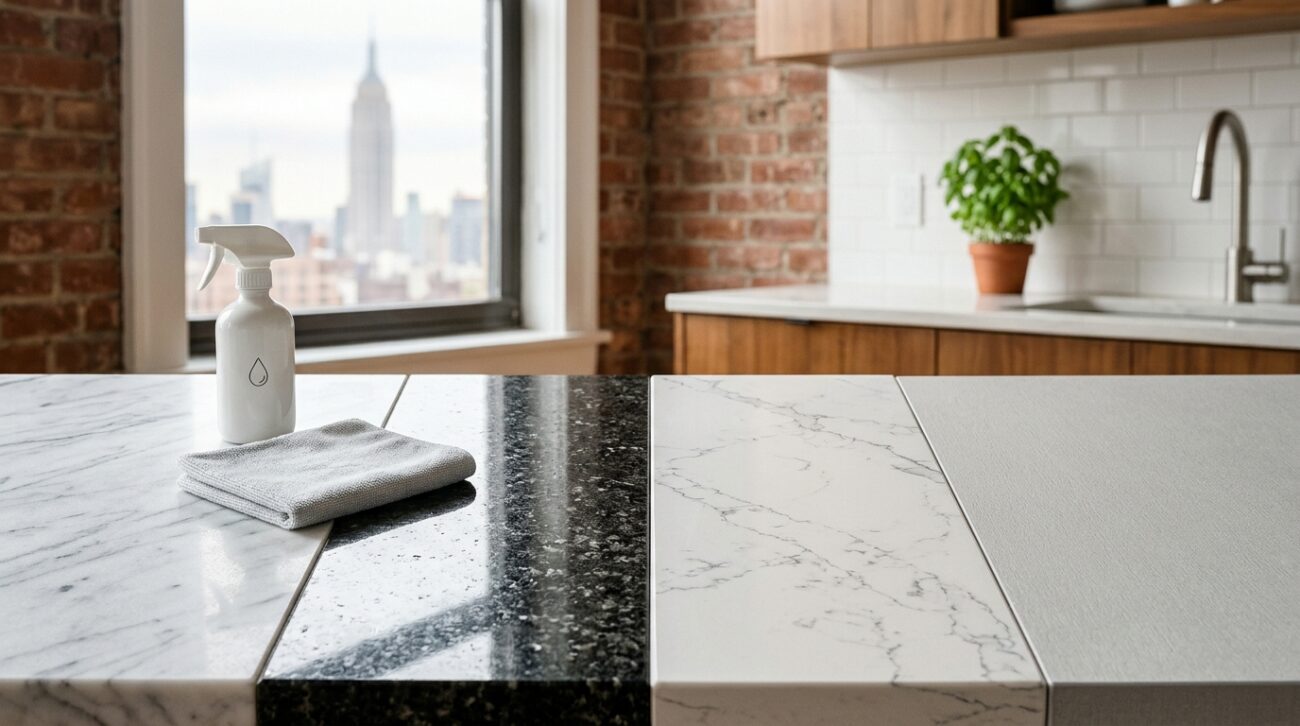
The difference comes down to what your counter is made of. Marble, granite, quartz, laminate, butcher block, and solid surface all look like “a counter” and all behave differently. Some stain. Some etch. Some scorch. Some are practically indestructible and need nothing more than soap and water. This guide helps you work out which one you have, what each one tolerates, how to deal with the most common stains, and how to build a routine that fits a small kitchen.
First, identify the material
You may not know what you have, especially in a rental. A few clues usually settle it.
Marble. Soft, cool to the touch, with soft, feathery veining that runs through the stone in irregular lines. Polished marble is glossy and reflective, honed marble is matte. If the counter shows dull, slightly rough spots where a glass or a bottle once sat, that’s etching, and it’s a strong sign of marble.
Granite. Speckled or flecked, with a crystalline look and visible grains of different colors. It rarely has the long, flowing veins of marble. Very hard and heat tolerant.
Quartz (engineered stone). Made of crushed quartz bound with resin. The pattern tends to be uniform and repeats, even when it’s designed to look like marble. Non-porous, and often has a slightly plastic-smooth feel. Common in new kitchens and renovated rentals.
Quartzite. Not the same as quartz. It’s a natural stone, very hard, often with marble-like veining, and sold as a durable alternative to marble. It doesn’t etch the way marble does.
Laminate. A printed surface over a particleboard core. Look at the edge. A thin line or seam where the decorative layer meets the front edge is a giveaway. Common in older and builder-grade apartments.
Solid surface (such as Corian). Smooth, uniform, and often seamless, with a slightly softer feel than stone. Sinks are sometimes built right into the counter.
Butcher block. Wood, with visible grain and end-grain or strips glued together.
Stainless steel. Metal, usually with a fine directional grain.
If you can’t tell, a simple test helps: put a few drops of water on the surface and leave them for 10 to 15 minutes. If the water beads and the surface stays unchanged, it’s sealed or non-porous. If it soaks in and leaves a dark spot, the surface is porous and probably needs sealing (common with granite and marble). If you’re renting, the lease or the landlord may name the material, and a dated photo of the counters at move-in is worth taking either way.
The shared basics
Whatever your counter is, a few habits apply across the board.
- Wipe daily with warm water and a drop of mild dish soap. It’s enough for almost every material, and it doesn’t build up a film.
- Dry the surface after wiping. Standing water leaves mineral spots on stone and swells laminate seams.
- Use a soft cloth or sponge. Microfiber works best.
- Clean spills quickly. Time is what turns a spill into a stain.
- Use trivets and hot pads, especially with the small appliances that crowd New York kitchens.
- Use cutting boards, not the counter itself.
- Read the label on any cleaner before using it on stone. “All purpose” does not mean “safe for all surfaces.”
Marble: gorgeous and fragile
Marble is made of calcium carbonate, which reacts with acids. Lemon juice, vinegar, tomato sauce, wine, soda, and many bathroom and kitchen cleaners will dissolve a thin layer of the surface and leave a dull spot called an etch. It isn’t a stain. It’s a tiny patch of surface that’s been chemically eaten away, and it shows most on polished marble, where it looks like a water mark that never dries.
What to do daily: wipe with warm water and a small amount of mild dish soap or a pH-neutral stone cleaner. Dry immediately. Use coasters under glasses, especially anything with citrus or alcohol.
What to avoid: vinegar, lemon, citrus-based or “natural” cleaners that contain citric acid, bleach, ammonia, abrasive powders, and anything labeled as a descaler. We cover the acid problem in more detail in our piece on hard water stains in NYC apartments, where marble in the bathroom is the usual victim.
If you etch it: light etching on honed marble can sometimes be blended with a marble polishing powder, applied according to the directions. Deeper or larger etches on polished marble are a job for a stone restoration professional, who hones and repolishes the surface. Don’t try scrubbing it out. That makes the dull patch bigger.
Sealing: marble is porous, and a good penetrating sealer slows staining, though it can’t stop etching because the damage is chemical. Check the seal with the water test above a couple of times a year.
Granite: tougher than it looks, but still porous
Granite is hard, heat tolerant, and rarely etches from food acids. Its weakness is porosity. Without a good sealer, oils and dark liquids can soak in and leave stains. Most granite is sealed when installed and needs resealing now and then.
What to do daily: warm water with a bit of dish soap, or a pH-neutral stone cleaner. Dry afterward.
What to avoid: harsh acidic cleaners over time (they can degrade the sealer, even if the stone itself isn’t etched), abrasive scrubs, and leaving oily or colored spills sitting.
Resealing: depends on the stone and the sealer, but the water test is the practical guide. If water darkens the stone within a few minutes, it’s time. Some granites need resealing every year or two, and others far less often.
Stains: oil stains (cooking oil, butter, grease) tend to appear as dark patches. A poultice of baking soda and water, mixed into a thick paste, spread over the stain, covered with plastic wrap, and left for 24 hours, can draw the oil out. Repeat if needed. For stubborn organic stains like coffee or wine on light-colored granite, a poultice using 3 percent hydrogen peroxide is a common approach. Test it somewhere hidden first, and never mix cleaning chemicals.
Quartz: nearly maintenance free, with two weaknesses
Engineered quartz is non-porous, so it doesn’t need sealing and resists stains well. For most people, it’s the easy counter. Two things hurt it.
Heat. The resin that binds the stone can scorch, discolor, or crack under sudden high heat. A pot straight off a burner, a hot pan from the oven, or a slow cooker running for hours can leave a permanent mark. Use trivets, always. Manufacturers often advise against putting anything above roughly 300 degrees Fahrenheit directly on the surface.
Harsh chemicals. Strong solvents, paint removers, oven cleaners, and aggressive degreasers can damage the surface. Bleach should be used only briefly and rinsed immediately, if at all. Prolonged strong sun can also yellow some light quartz over time.
What to do daily: warm water, dish soap, and a soft cloth. For dried-on spots, a plastic scraper held flat lifts them without scratching. For grease, a non-abrasive kitchen degreaser works, rinsed well afterward.
What to avoid: scouring powders and abrasive pads, which dull the polish, and cleaners that leave a film.
Laminate: practical, and afraid of water at the seams
Laminate (often called by the brand name Formica) is common in older and budget kitchens. It’s easy to clean, and it’s inexpensive to replace, but it has its own risks.
What to do daily: warm water and dish soap, wipe, dry. A diluted all-purpose cleaner is fine.
What to avoid: standing water at seams and edges, which gets into the particleboard and causes swelling that can’t be repaired. Hot pans, which can blister or discolor the surface. Abrasive pads and powders, which scratch the printed layer. Cutting directly on the surface.
Stains: a paste of baking soda and water on a soft cloth lifts most. Rinse well.
Butcher block and wood counters
Wood needs different care than stone. It’s naturally absorbent and responds to moisture and oil.
- Clean with a soft cloth, warm water, and a drop of mild soap. Don’t soak.
- Oil it regularly, with food-grade mineral oil or a butcher block conditioner, as often as the wood looks dry (many people do it monthly at first, then less often). Oil keeps the wood from drying, cracking, and absorbing stains.
- Sanitize after raw meat with hot soapy water, then a wipe with diluted white vinegar or a food-safe sanitizer. Rinse and dry.
- Fix scratches and stains by lightly sanding with fine-grit sandpaper, then re-oiling.
Solid surface and stainless steel
Solid surface is forgiving. It has no seams to trap dirt, and scratches can usually be buffed out with a mildly abrasive pad, following the manufacturer’s instructions. Avoid putting hot pans on it directly.
Stainless steel shows fingerprints and water marks but is otherwise sturdy. Wipe with the grain, not against it or in circles, using a soft cloth with warm water and dish soap. Avoid bleach and chlorine cleaners, which can pit the metal. Wipe dry for a streak-free finish.
A quick reference
| Material | Etches | Stains | Heat | Needs sealing | Best daily cleaner |
| Marble | Yes, easily | Yes | Good | Yes | Warm water, mild soap or stone cleaner |
| Granite | Rarely | If unsealed | Very good | Usually | Warm water, mild soap or stone cleaner |
| Quartz | No | Rarely | Poor | No | Warm water and mild soap |
| Laminate | No | Rarely | Poor | No | Warm water and mild soap |
| Butcher block | No | Yes | Fair | Oil regularly | Soap and water, then oil |
| Solid surface | No | Rarely | Fair | No | Warm water and mild soap |
Common spills and what to do first
Speed matters more than the product. The first move is always the same: blot, don’t wipe, so you lift the spill instead of spreading it, then wash with warm water and mild soap.
- Coffee, tea, and wine. Blot, wash, and dry. On marble, remember that wine and many teas are acidic and can etch even after the color is gone. On light granite, an old stain may respond to a hydrogen peroxide poultice.
- Cooking oil and grease. Wipe the surface with dish soap and hot water right away. Oil that has soaked into unsealed stone needs a baking soda poultice.
- Water rings. On stone, these are usually mineral spots or a light etch. Dry the surface, then try a stone-safe cleaner. On laminate and wood, they can mean moisture has gotten under the surface, so dry the area quickly.
- Rust rings from cans and metal. Steel cans and cast iron pans left wet leave orange rings, especially on porous stone. A commercial rust remover made for your type of stone is the safe route, because household acids will hurt marble and can degrade sealers.
- Dried-on food. Soften with a warm, damp cloth for a minute, then lift with a plastic scraper held flat. Never use a metal blade on stone or quartz.
- Hard water spots near the sink. Dry the counter after each use, and keep acidic descalers off stone entirely.
A word on sealers
Sealer is the least understood part of stone care. A penetrating sealer sinks into the pores and slows liquids from soaking in, which gives you time to wipe up a spill before it stains. It doesn’t make stone stain proof, and it doesn’t protect against etching.
Two practical points. First, check the seal with the water test rather than relying on a calendar. Put a small puddle of water on the stone in the area you use most, and if it darkens the stone within about ten minutes, it’s time to reseal. Second, follow the product’s instructions exactly: clean and dry the surface fully, apply an even coat, wipe off the excess, and give it the cure time on the label. A poorly applied sealer leaves a hazy film that is harder to fix than the original problem. If you rent, ask your landlord before resealing anything, and if the stone is high value or large, a pro can do it quickly.
Small-kitchen problems
New York kitchens add a few habits that take a toll on counters.
The counter is also a table, a desk, and a prep area. Wipe it more than once a day, and put a mat under the laptop so there’s no grit between machine and stone.
Appliances live on the counter. Air fryers, toaster ovens, pressure cookers, and slow cookers all produce heat from below. Put a trivet or silicone mat under them, and leave a gap behind them so heat can escape. Heat marks on quartz and laminate are common, and permanent.
Plants, bowls, and bottles leave rings. A plant saucer that leaks, an olive oil bottle that drips, and a wine glass that sweats all leave marks on stone. Give them a tray or a coaster.
Cleaning products live under the sink. A leaking bottle of drain cleaner or degreaser can soak into stone and laminate edges. Check what’s stored there.
The backsplash and the edge. Grease collects at the back of the counter and along the edge near the stove. Wipe these daily, because dried grease is what makes a counter feel tacky.
What not to use, on any natural stone
A short list, because these appear in most kitchens:
- Vinegar and lemon-based cleaners
- Bleach
- Ammonia-based glass cleaners
- Abrasive powders and scouring pads
- Magic erasers on polished surfaces, which act like extra-fine sandpaper and dull the finish
- Disinfecting wipes with citric acid or strong chemicals
For occasional disinfecting, many manufacturers accept a diluted isopropyl alcohol solution on sealed stone and quartz, rinsed and dried afterward. Check your countertop manufacturer’s care guide first.
For renters
You usually can’t replace or reseal rental counters, so the goal is to keep them as you found them. Take dated photos at move-in, including any existing etches, burns, chips, or stains. Avoid the products on the “never” list above, and use trivets. If you find damage you didn’t cause, report it in writing. Our guide to deep cleaning a small NYC kitchen covers the rest of the kitchen, including the surfaces around the counter.
When to get help
A stone restoration specialist is worth calling for:
- Deep etching on polished marble
- Large stains that haven’t responded to a poultice
- Cracks or chips in stone or quartz
- Resealing a large area of natural stone
- Scorch marks on quartz or solid surface
For the daily routine, a regular standard cleaning wipes down counters as part of the kitchen. What it can’t do is undo a chemical burn, so the product choice you make between visits matters most.
The short version
Find out what your counter is. Wipe it daily with warm water and mild soap, and dry it. Keep acids off marble, heat off quartz and laminate, oil off unsealed stone, and standing water off laminate seams. Use trivets and cutting boards, and clean spills quickly. For stains, try a poultice before a stronger product, and when in doubt, leave the harsh cleaner on the shelf.
Skip the Cleaning. Keep the Weekend.
Book your cleaning in 60 seconds — we handle the rest.
Book Now