Somewhere around the eighth month, a switch flips. You look at the apartment and see every flaw at once: the dust behind the dresser, the grout in the bathroom, the radiator nobody has touched since move-in. The urge to scrub everything before the baby arrives is so common it has a name (nesting), and it’s real.
The trouble is that “clean everything” isn’t a plan. It runs out of time, it wears out a person who is already carrying twenty extra pounds, and it spends hours on surfaces a newborn will never touch while skipping the ones that matter in week one.
A newborn doesn’t crawl, doesn’t mouth the floor, and doesn’t leave the bassinet unless someone is holding them. What changes in those first weeks is how the adults use the apartment: where they sleep, where they feed, how often they wash their hands, and how little energy they have left for anything else. A good pre-baby clean is built around that. This guide covers what to prioritize, what to leave for later, and what’s particular to doing it in a New York apartment, where the nearest laundry machine may be four floors down and the front door may be at the top of a staircase.
Start with a different question
Don’t ask “What could possibly be dirty?” Ask “Where will we actually spend the first two weeks?”
For most families, the answer is four places: the bed, wherever feeding happens, the bathroom, and the path between the front door and all three. That’s a small slice of a New York apartment. If you put your effort there and get it right, the rest of the place can wait.
It also helps to think in two phases, because the cleaning has two different jobs.
Before the birth is for the heavy, slow, scrubbing work: the kind that needs ventilation, a stepstool, or strong arms. Do it while you’re mobile, and ideally while someone else does the bending.
Just before homecoming is light and fresh: clean sheets, an empty trash can, a cleared counter, clean air. This is the layer that makes walking in feel calm.
Mixing the two is how people end up scrubbing a bathtub at 2 a.m. the night before a due date.
A realistic timeline
Babies keep their own schedule, so build your plan around a window, not a date.
Around weeks 32 to 35: the heavy jobs. Oven, fridge, bathroom grout, inside of cabinets, window sills, baseboards behind furniture, the stubborn corners. If you’re going to hire help for any of it, this is the time to book, because availability tightens as due dates approach. A deep cleaning covers most of this list in one visit.
Weeks 36 to 38: the soft stuff. Wash baby clothes, receiving blankets, crib or bassinet sheets, and any fabric the baby will lie on. Vacuum the mattress. Set up the changing area. Declutter the paths you’ll be walking at 3 a.m.
After the bag is packed: the last pass. Dishes done, trash out, bed made, bathroom wiped, a few meals in the freezer. This is the layer that has to be fresh when you walk back in, and if the baby arrives early it should take under an hour.
Hospital stays are usually short, typically a day or two after a vaginal birth and a few days after a cesarean, so the gap between leaving and coming home is brief. The point is that nothing gets half done. A home that’s 80 percent clean and calm beats a home that’s 100 percent scrubbed on the surface and chaotic underneath.
The air comes first
Of everything on the list, air quality is the most overlooked and the cheapest to fix.
You’ve probably got the instinct to mop, wipe, and disinfect as a last step. Resist the part of that instinct that reaches for strong fragrance. A freshly bleached, pine-scented, plug-in-air-freshened apartment smells clean, but it also fills the air with volatile organic compounds, the gases that come off many cleaning products, air fresheners, and scented candles. The EPA notes that indoor concentrations of many of these compounds run higher than outdoors, and cleaning and fragrance products are among the sources. A newborn’s lungs are small and still developing, and a recovering parent is often more sensitive to smells than usual.
A better approach:
- Clean with simple, low-fragrance products. Dish soap, a plain all-purpose cleaner, and hot water handle nearly everything. Skip the aerosol sprays.
- Finish the strong-smelling jobs early. Oven cleaner, bleach on grout, and anything with fumes should happen weeks before the baby comes home, with windows open.
- Air the apartment out in short bursts. In January you aren’t going to leave windows open all day. Ten to fifteen minutes of cross-ventilation, a few times a day, replaces stale air without chilling the place.
- Skip the candles and incense. Burning anything indoors adds fine particles and residue to the air right when you least want it. (If you’ve been burning them regularly, wiping down the shelves and window glass is worth doing, because the residue builds up on surfaces.)
If the apartment smells like nothing, that’s the goal. Clean smells like nothing.
Zone by zone: where to put your effort
The bed and bedroom
Wherever you sleep is where you’ll spend most of your time in the first weeks, and not much of it asleep. Treat it like a small hotel room.
- Change the sheets right before you leave, and keep a second set within reach for the nights things need changing.
- Vacuum the mattress and flip or rotate it if it allows.
- Clear the nightstand and leave only what you’ll reach for: water, phone charger, lip balm, a lamp you can turn on without waking anyone.
- Make a clear path from the bed to the bathroom, with nothing on the floor to trip on in the dark.
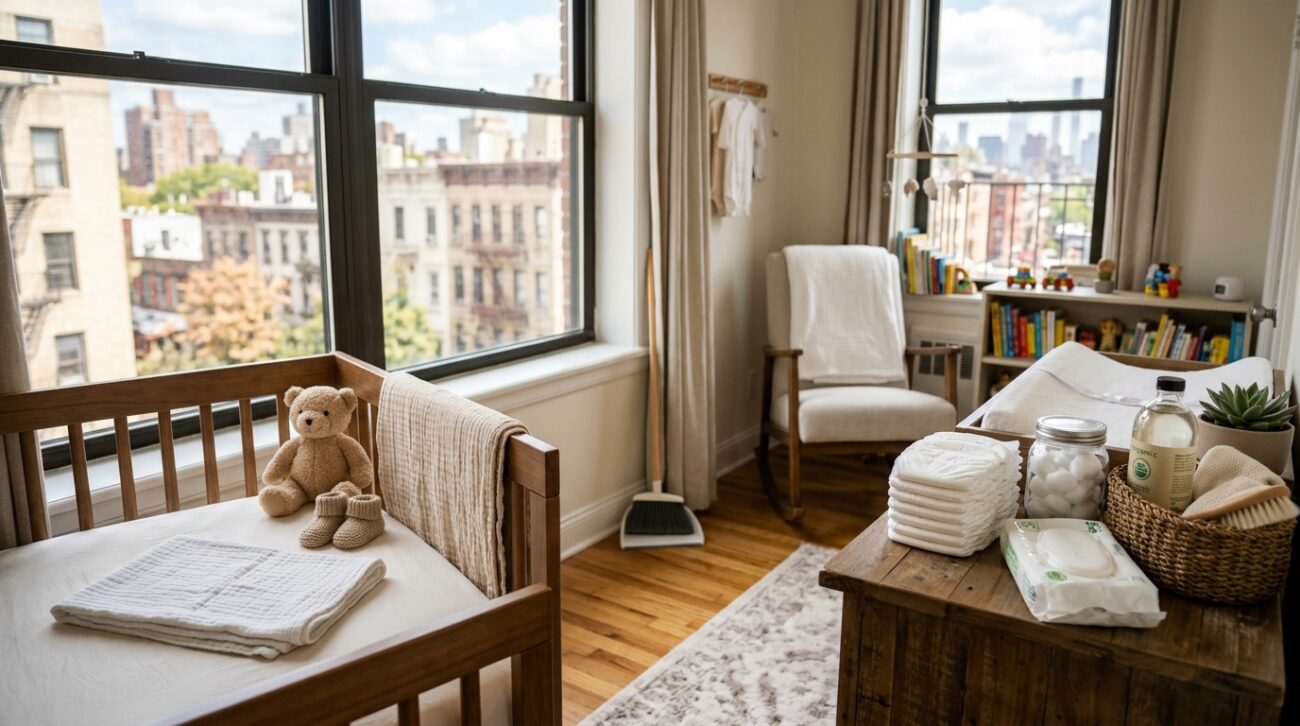
If a bassinet or crib is going in your room, wipe down the frame and the mattress cover, and wash the sheets. The American Academy of Pediatrics recommends a firm, flat sleep surface with a fitted sheet and nothing else in the sleeping space, no pillows, bumpers, or loose blankets. That makes cleaning the sleep area easy: there’s less in it to clean.
The feeding station
Whether it’s a nursing chair, a couch corner, or the kitchen table, the place where feeding happens needs three things: a surface that’s easy to wipe, a spot for supplies, and a trash can nearby.
If you’ll be using bottles or a breast pump, the kitchen needs a plan too. The CDC recommends washing pump parts, bottles, and nipples after every use, in a clean basin and not directly in the sink, with soap and warm water, and sanitizing them daily for babies under three months old or those with a weakened immune system. Setting up a dedicated drying rack, a wash basin, and a bottle brush before the baby comes saves a lot of fumbling later. Give that corner of the counter a deep wipe and clear it of everything that isn’t baby related.
New York tap water, for what it’s worth, is safe to use for formula and bottles according to the city’s Department of Environmental Protection. You don’t need to buy bottled water. Run the cold tap for a bit, and don’t use the hot tap for formula, since hot water can pick up more metals from old plumbing.
The bathroom
You’ll spend more time here than you expect, and so will the person recovering. Aim for clean, unscented, and easy to maintain.
- Scrub the tub and toilet with a plain cleaner that rinses off well.
- Clean the floor well enough that you’d feel comfortable sitting on it.
- Empty and reline the trash can, and keep a spare bag in the cabinet.
- Clear the counter and keep a small basket for the things you’ll use daily.
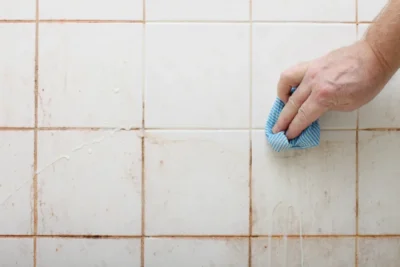
If your bathroom has grout that has seen better days, that’s a heavy job for weeks 32 to 35, not the night before.
The entry and the laundry situation
New Yorkers often forget the entry, and it’s the first thing you meet when you come home carrying a car seat and a bag. Give it a clear landing spot: a place to put the seat, a hook for the diaper bag, a mat for shoes. If you’ve decided on a no-shoes policy, set up the shoe rack now, before it becomes a request you have to make to every visitor.
Laundry deserves its own paragraph. In a walk-up building with a basement laundry room or a trip to the corner laundromat, the hamper tends to fill faster than the washer can empty it. Before the baby arrives, run every load you can, empty the hampers, and fold things into drawers. Many families find it easiest to wash the baby’s first clothes and blankets in a gentle, fragrance-free detergent, though any mild detergent works. There’s no need for a special “baby” product.
What to leave for later
Anything that doesn’t touch the first two weeks can wait for the six-to-eight week mark, when you have a bit more energy:
- Ceiling fans and light fixtures
- Window tracks
- The tops of cabinets
- The inside of drawers and closets
- Oven interior, unless it’s actually dirty
- Decorative items
Don’t let any of these become a reason to climb a stepstool in your ninth month.
What to protect yourself from while cleaning
A few safety notes for the parent-to-be, because pregnancy changes what’s sensible to do.
- Skip the cat litter. The CDC advises pregnant people to avoid changing cat litter because of the risk of toxoplasmosis. If you have a cat, hand that job to someone else for the duration.
- Avoid fumes. Oven cleaner, bleach, and anything with a strong smell needs open windows or someone else’s lungs.
- Never mix products. Bleach and ammonia, or bleach and vinegar, release dangerous gases. This is true at any time and especially worth repeating now.
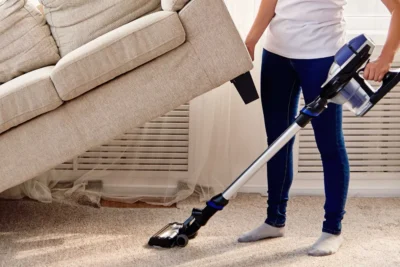
- Delegate the heavy lifting and high reaching. Moving furniture to clean behind it, climbing a ladder for a light fixture, and scrubbing floors on your knees are all good jobs to hand off.
If the idea of doing none of this yourself sounds appealing, you’re not alone. Plenty of people treat a professional clean as the one baby-related expense that pays for itself. A friend, relative, or coworker can also pitch in with a gift of cleaning rather than another onesie.
A NYC detail worth knowing: lead dust
If your building was built before 1960, there’s a chance it contains lead paint, and New York City law requires landlords of pre-1960 buildings to inspect for it and fix it in apartments where a child under six lives. Lead isn’t a newborn homecoming problem, since a baby who isn’t mobile isn’t touching sills or chewing on window frames. But it’s worth knowing before the crawling stage arrives.
Lead dust forms when old paint on windows, doors, and friction surfaces chips or wears. The city’s health department recommends wet cleaning, which means wet mopping floors and wet wiping window sills, and avoiding dry sweeping or dry dusting, which kicks the dust into the air. If you see peeling or chipping paint in a pre-1960 apartment, report it to your landlord in writing. This is also one more reason to use a damp cloth, not a dry duster, on sills in older buildings.
Hand hygiene beats disinfecting
There’s a temptation to disinfect everything before a baby comes home. For a healthy newborn at home, that’s mostly unnecessary. What matters far more is how often hands get washed, particularly before touching the baby, after changing a diaper, and after coming in from outside.
Set up for that:
- A pump soap dispenser by the kitchen sink and in the bathroom.
- A small stack of clean hand towels, replaced every day or two.
- A bottle of hand sanitizer by the front door for visitors.
Regular soap and water handles most surfaces. If you want to understand when disinfecting does matter and when it just adds chemicals, our explainer on cleaning versus sanitizing versus disinfecting lays it out. For a newborn’s first weeks, the short version is: clean visibly dirty things, sanitize bottle parts, and keep sick visitors away.
Where all the baby gear goes
A newborn arrives with a surprising amount of equipment: a stroller, a car seat, a bassinet or crib, a bouncer, a changing pad, bags of diapers, and a mountain of tiny clothes. In a 600 square foot apartment, none of it has an obvious home, and clutter is what turns a clean apartment back into a stressful one within a week.
Decide where things live before they arrive:
- The stroller needs a spot near the door that doesn’t block the exit. In a walk-up, many people fold it and carry it up, so check that the landing area can take a folded stroller without anyone tripping over it.
- Diapers and wipes belong in two places, not one: the changing area and a small stash wherever you spend your daytime hours. Running to another room mid-change is how things go wrong.
- Clothes in the first months get outgrown in weeks. Keep one drawer of what fits now and bag the rest by size, so the drawer never overflows.
- Spare laundry baskets save trips. One for baby items, kept separate from the adults’ laundry, makes sorting trivial.
If storage is tight, edit before the baby arrives, not after. The principle: empty surfaces and clear floors are the cleaning that keeps working after the cleaning is done.
Visitors, and the house rules that make them easy
Family and friends will want to come by in the first weeks, and they’ll arrive with the best intentions and whatever germs they picked up on the subway. It’s reasonable to set a few ground rules, and it’s much easier to do so before the baby comes than while you’re exhausted.
- Wash hands at the door, with soap, before anyone holds the baby.
- No visits from anyone who feels sick, even a little.
- Shoes off at the entry, with a mat or rack ready.
- Visitors can help: take out a bag of trash, load the dishwasher, or fold a load of laundry.
That last rule is the one worth making official. Most visitors want to be useful and don’t know how. Handing someone a short list of small jobs turns a visit into real help.
The actual homecoming checklist
If the baby arrives and you’ve done nothing else, this list is enough:
- Fresh sheets on the bed, a second set within reach
- Empty trash cans, all relined
- Empty sink, dishwasher run or dishes done
- Fridge cleared of old food and stocked with a few easy meals
- Clean, unscented bathroom
- Clear path from the front door to the bed
- Windows opened briefly to air the place out
- Hampers emptied and laundry done
- A place for the car seat and a hook for the bag
- A wash basin, bottle brush, and drying rack set up if you’re bottle or pump feeding
Notice what’s missing: baseboards, window tracks, the inside of the oven. Nobody has ever regretted skipping them.
When the baby starts to move
Around four to six months, babies roll, scoot, and start grabbing and mouthing things. That’s when floor-level cleaning starts to matter: the floors themselves, the edges of rugs, the lower shelves, the outlet covers, the radiators. It’s a second, separate round of cleaning, built around a different set of risks. Our guide to keeping a clean home with kids in NYC picks up from there.
For now, the job is simple. Get the air clean, the bed fresh, the kitchen workable, and the bathroom calm, then stop. The point of cleaning before a baby comes home isn’t a perfect apartment. It’s an apartment that asks nothing of you in the first two weeks.
Not Sure What You Need?
Tell us about your space — we'll recommend the right service and give you a free, no-obligation quote.
Get a Free Consultation