You spend roughly a third of your life on your mattress, and most people wash it about as often as they wash the ceiling. In a NYC apartment that math gets worse. The bed is usually the largest piece of furniture in the room, there is rarely a yard to drag it into, and the one rented mattress you inherited with the place has seen at least one previous tenant. A few simple habits keep it clean, and a few specific methods rescue it when something goes wrong at 2 a.m.
This guide covers the basic routine that works on every mattress, the adjustments for foam, latex and hybrid beds, the stain recipes for the things that actually end up on a mattress, and the point where cleaning stops being the right answer.
What Is Actually Living in Your Mattress
Even if you change the sheets every week, your body keeps working through the night. Sweat, natural skin oils and dead skin cells pass through the sheet and into the top layers of the mattress. Dust settles into the seams. Dust mites, which are microscopic and feed on skin flakes, thrive in a warm, slightly humid bed. They do not bite, but they can trigger itchy skin and allergy symptoms in some people, as Tom’s Guide notes in its mattress care guide.
Add the occasional accident, a coffee spilled during a Sunday movie, a pet that sleeps on the bed, a child with a cold, and the surface collects a lot more than it shows. Stains sit on top, but deeper moisture is the larger problem. Liquid that sinks into the padding takes a long time to dry, and a mattress that stays damp can grow mold and hold odors for months.
Yellow patches are normal, by the way. They come from sweat, urine and body oils reacting with air. They are cosmetic until they smell, and then they need action.
How Often to Clean a Mattress
A schedule helps more than motivation. Here is a rhythm built from the guidance in Tom’s Guide and This Old House:
| How often | What to do |
| Weekly | Wash sheets. Vacuum the mattress if you can (monthly is acceptable) |
| Monthly | Spot treat stains, sprinkle baking soda, vacuum it away |
| Every three months | Wash the mattress protector and rotate the mattress, if the maker recommends it |
| Every four months | Air the mattress out with the bedding off |
| Every six months | Full deep clean, and wash the pillows |
If you share the bed with a pet, sleep hot, or live with allergies, bring those intervals closer together. If you have a guest room bed that sits unused, twice a year is fine.
What You Need
Everything on this list is cheap and probably already in your kitchen.
- A vacuum with an upholstery attachment and a crevice tool
- Baking soda
- Distilled white vinegar
- 3 percent hydrogen peroxide (the brown bottle from any drugstore)
- Mild dish soap or a bleach-free laundry detergent
- Clean white cloths or paper towels, and a few microfiber cloths
- A spray bottle
- A soft brush or an old toothbrush
- Optional: cornstarch, rubbing alcohol (70 percent or higher), a fan
Use white cloths. A colored one can bleed onto a wet mattress, and then you have a new stain to deal with.
The Basic Routine: Every Mattress, Every Time
This is the cleaning that handles dust, mites and general freshness. Do it every month or two.
1. Strip the bed. Take off everything, including the mattress protector. Toss the sheets and protector in a hot wash if the care labels allow. Hot water helps against dust mites.
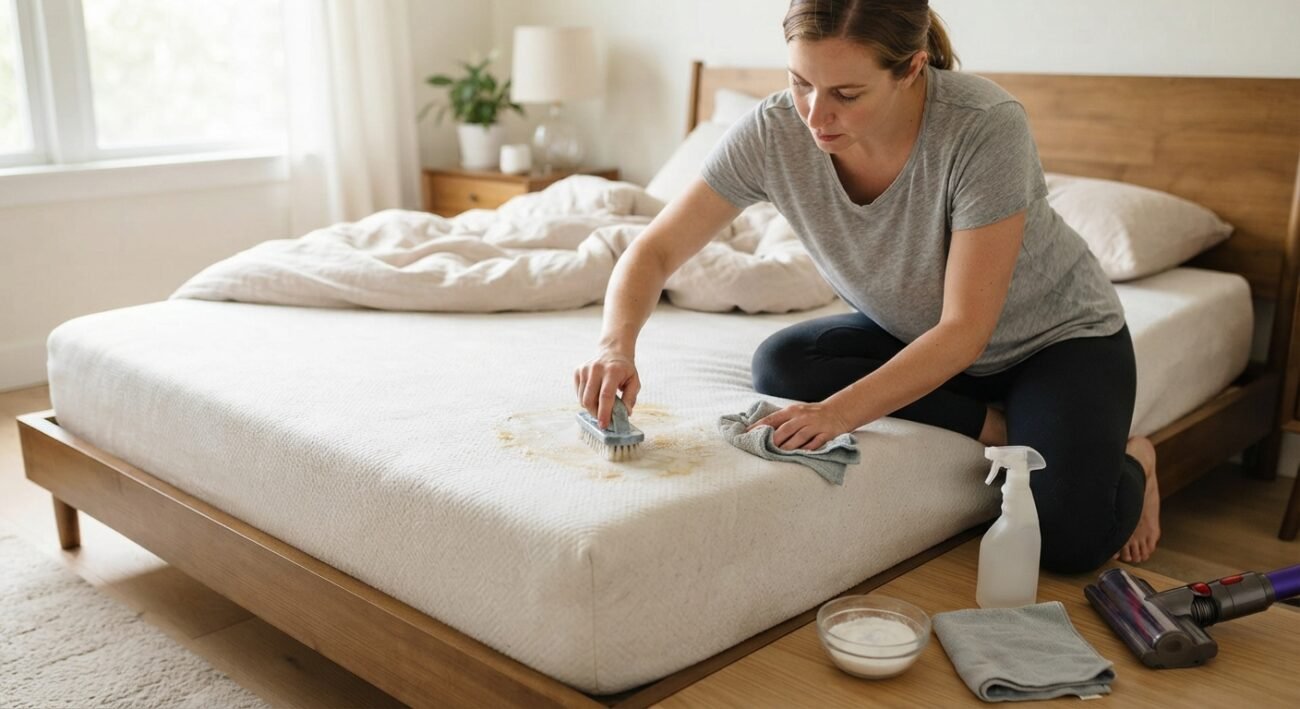
2. Vacuum the whole surface. Use the upholstery attachment, not the bare hose, so you do not scuff the fabric. Then switch to the crevice tool and go along the piping, the seams and any tufts, where dust and hair collect. Bob Vila points out that this step also keeps the dust mite population down, which matters for anyone with allergies.
3. Sprinkle baking soda. Spread a thin, even layer over the entire top. Leave it for at least an hour. More is better, and several hours or overnight works well if you can plan around it. The baking soda draws out moisture and odors.
4. Vacuum it up. Go slowly, because baking soda is fine and hides in the seams. Check that nothing is left behind.
5. Air it out. Leave the mattress bare for a while with a window open. A few hours of airflow takes away that stale feeling and helps prevent moisture buildup. If you have a helper, stand the mattress against the wall so air reaches all sides.
That is it. It takes about fifteen minutes of actual work plus waiting time.
Adjust for Your Mattress Type
Not every mattress tolerates the same treatment. A mistake with moisture or heat can cause real damage.
Innerspring and standard mattresses. These are the most forgiving. You can spot clean with a damp cloth, and This Old House says they can handle a few hours of sunlight to freshen up, though that is easier in a house than a fifth floor walk-up. Always let them dry fully.
Memory foam. Foam absorbs liquid quickly and releases it slowly, which makes mold a risk. Use as little liquid as you can. Spray only the stained spot with a mix of mild detergent and water (This Old House gives a ratio of about one part soap to two parts water), then blot with a dry cloth. Do not soak it. Dry it with a fan, not heat. Tom’s Guide warns that heat damages the foam structure and makes it break down faster. That includes a radiator, which NYC apartments have in abundance, so keep the mattress away from one while it dries.
Hybrid mattresses. These combine foam layers with springs, so treat them like foam: little moisture, no heat, and patience. Tom’s Guide suggests spraying stains with equal parts white vinegar and water, sprinkling baking soda on top, working it in gently, waiting about 20 minutes, then vacuuming and blotting with cold water.
Latex. Natural latex is durable but sensitive to moisture and heat. Use low suction when vacuuming, because high suction can pull and distort it. Spot clean with water and a teaspoon of mild soap. Do not put it in direct sunlight, since UV can make latex discolored and brittle.
Organic and wool mattresses. Cotton and wool are absorbent and can shrink. Lightly mist stains, never soak, and blot dry. Vacuum on low suction. Rotate head to foot afterward.
If you are not sure what you have, check the tag at the foot of the mattress or the brand’s website. When in doubt, go with the foam rules.
How to Remove Common Mattress Stains
Three rules apply to every stain:
- Blot, never rub. Rubbing pushes the liquid deeper into the padding and spreads the stain.
- Use as little liquid as you can. Mist, do not pour.
- Test first. Try any solution on a hidden spot, like the side near the bed frame, before you treat a stain where it shows.
Urine
Act quickly. Blot up as much as possible with a dry cloth. Then:
- Fresh stain. Spray with equal parts white vinegar and water, sprinkle with baking soda, and leave it for several hours. This Old House says 8 hours or more. Vacuum the dried powder away and repeat if the smell lingers.
- Dried stain. This Old House suggests mixing 8 ounces of hydrogen peroxide with 3 tablespoons of baking soda, a couple of drops of dish soap, and a few drops of essential oil. Spray the stain generously, let it dry completely, and vacuum. For odor that hangs on, Tom’s Guide suggests a light mist of rubbing alcohol (at least 70 percent) over the area, which helps break down organic matter. If you have pets or small children, an enzyme cleaner made for urine is a solid second step, and This Old House recommends enzyme products for vomit and excrement too.
Sweat
Sweat gives you the yellowing and the funk. Tom’s Guide mixes equal parts white vinegar and cold water, sprays the stain, blots, then covers it with equal parts baking soda and cornstarch for about four hours before vacuuming. This Old House has a different recipe: equal parts hydrogen peroxide, dish soap and water, left on the stain for 15 to 20 minutes, then blotted and fan dried. Both work. Use the vinegar version on delicate or dark fabric and save the peroxide for stubborn stains.
Blood
Always use cold water, never hot, because heat sets protein stains. Bob Vila chills the peroxide and baking soda mix in the fridge for an hour before using it. Tom’s Guide has a faster version: spritz the stain with cold water, blot, dab on 3 percent hydrogen peroxide, sprinkle with baking soda, and let it fizz for about ten minutes before blotting. For an old, dried stain, This Old House uses a paste of unseasoned meat tenderizer and cold water, left for about 30 minutes. The enzymes break down the protein.
Vomit
Remove any solids first with paper towels. Mix one part white vinegar to two parts water, dampen a cloth, and blot. Follow with a cloth dipped in cold water and a little mild soap. Repeat until it lifts. For the smell, baking soda with a couple of drops of essential oil can sit for six to eight hours, ideally overnight.
Coffee, Wine and Food
Soak up what you can, then use a spray of about one part laundry detergent, one part vinegar and ten parts water (Bob Vila) or a quarter cup of vinegar with a tablespoon of dish soap in three quarters of a cup of warm water (This Old House). Let it sit for 10 to 15 minutes, blot with a damp cloth and then a dry one, and repeat. For red wine, a mixture of hydrogen peroxide and dish soap in a ratio of three to one is the version This Old House gives.
Rust
Rust marks come from the coils inside the mattress when moisture reaches them. A paste of vinegar, lemon juice and salt, applied with gloves on and blotted away, can lift small spots. If rust keeps returning, the mattress has a moisture problem.
Cleaning a Mattress in a Small NYC Bedroom
Most of the advice above assumes you can stand the mattress on its edge, carry it outside or leave it bare for a day. A lot of NYC bedrooms have none of that room. A few workarounds make the job realistic.
Work in zones. Clean the top surface first, let it air for an hour or two, and then deal with the sides. You do not have to treat the whole bed in one afternoon.
Use the tub as a staging area. Wet cloths, spray bottles and the bucket live there, so nothing drips on the floor of a room you also sleep in.
Protect the floor. Lay down an old towel along the side of the bed before you start. Baking soda is easy to vacuum off a rug and harder to chase out of a crack between floorboards in an older building.
Plan the drying. In a studio, the bed may also be the sofa. Time the work for a day you are out, open a window, and aim a fan across the mattress. A bed that is still damp at bedtime is the thing to avoid, not a slow Saturday.
Check the frame. If your bed sits on a platform with storage drawers, a dust layer under the mattress is common, and it is worth lifting the mattress once in a while to see what is down there.
Dry It Properly
Most mattress disasters are caused by cleaning too enthusiastically and drying too little. Aim for a fully dry mattress before you put on sheets. A fan pointed at the spot for a few hours works well, and a window cracked open helps even in January, since moving air matters more than warm air. Bob Vila allows a hair dryer on the cool setting, but keep it away from foam. If time matters, sleep on the couch or an air bed for a night rather than trap moisture under a sheet.
Never use heat to hurry a foam mattress. That includes heating pads, space heaters and the radiator beside the bed.
Dust Mites and Allergies
If you wake up congested or itchy, the mattress may be part of it. The steps that help are boring and effective: vacuum regularly with the upholstery tool, wash bedding in hot water, and use a mattress encasement that zips around the whole mattress. Tom’s Guide lists the encasement as a good protective step against dust mites and other allergens. We go deeper on this in our guide to cleaning allergens out of your home, which treats the whole apartment rather than only the bed.
Home methods only reach the surface layers. For a deeper treatment, Cleaning Chief’s carpet and couch cleaning includes mattress steam cleaning, where high-temperature steam pulls dust mites, allergens, sweat stains and odors out through the fabric. It is the same hot extraction logic used on sofas and rugs, applied to the bed, and it is the usual next step when vacuuming and spot treatment have stopped making a difference. Check the material first, though, since steam can damage memory foam.
Bed Bugs: What to Do and What Not to Do
Bed bugs are a real concern in a big dense city, and a mattress is where they are most often discovered. Do not try to solve a confirmed infestation with baking soda. Strip the bedding and wash it on a hot cycle, vacuum the mattress and empty the vacuum into a sealed bag you take outside, and use a zippered encasement. Tom’s Guide cautions that steam can damage memory foam and says an exterminator is the best choice there. If you rent, tell your landlord or building manager right away. This is a building problem, not just a bedroom problem.
Mattress Mold
Mold on a mattress is a health matter. Tom’s Guide describes it as a risk for respiratory problems and allergies, formed by trapped moisture from sweat, spills or humidity. For small patches, spray equal parts water and white vinegar, gently scrub visible spots with a soft brush, then lightly mist with rubbing alcohol and blot. Dry it thoroughly and vacuum into a sealed bag. If mold comes back or covers a large area, replacing the mattress is the safer choice. More on that general problem in our piece on mold and mildew in NYC apartments.
Keep It Clean Longer
A few habits do more than any product.
- Use a mattress protector. It is the single best upgrade. A waterproof, breathable protector catches spills, sweat and allergens, and it goes in the washing machine, which a mattress does not.
- Air the bed. Leave it unmade for a few hours each morning, so moisture escapes instead of staying under the covers.
- Wash sheets weekly. Dirty sheets pass sweat and oil straight through to the mattress.
- Shower before bed. This Old House suggests it, since less sweat and body oil reaches the mattress.
- Skip eating and drinking in bed. The most common mattress stains are coffee, wine and snacks.
- Rotate if the maker says so. Some mattresses are no-flip and no-rotate, so check the instructions.
Visible stains can also affect your warranty. Bob Vila notes that in most cases a visible stain will void a mattress warranty, which is one more reason to use a protector.
When It Is Time to Replace the Mattress
Cleaning cannot fix a worn mattress. This Old House puts the replacement window at seven to ten years. Replace sooner if:
- Odors stay after repeated cleaning
- Moisture has soaked deeply or mold keeps returning
- The mattress sags, or you wake up with new aches
- You have had a bed bug infestation and cleaning cannot clear it
If you are renting, document the mattress condition when you move in. A landlord provided mattress with stains from a previous tenant is a conversation to have in writing.
The Short Version
Vacuum monthly. Spot treat stains right away with a little liquid and plenty of blotting. Use baking soda for odors. Keep foam away from heat and excess water. Use a protector, and replace the mattress when cleaning stops working. The rest is fine detail.
Not Sure What You Need?
Tell us about your space — we'll recommend the right service and give you a free, no-obligation quote.
Get a Free Consultation