Most business owners use “commercial cleaning” and “janitorial cleaning” as if they’re the same thing. They’re not — and mixing them up is exactly how offices end up either overpaying for services they don’t need, or discovering too late that the “cleaning company” they hired was never going to touch their carpets.
The short version: janitorial cleaning keeps a space running day to day. Commercial cleaning restores it periodically. One is maintenance. The other is a reset. Most NYC businesses need both, just on very different schedules — and knowing which is which changes how you budget, how you set expectations with a vendor, and how you catch a gap before it becomes a visible problem in your lobby.
Janitorial Cleaning: The Day-to-Day Work
Janitorial cleaning is what keeps an office, retail store, or medical suite functional between one visit and the next. It’s recurring by design — daily, a few times a week, or weekly, depending on how the space gets used — and it’s built around the tasks that pile up fastest if nobody handles them.
A typical janitorial visit covers:
- Trash removal and liner replacement
- Vacuuming carpets and mopping hard floors
- Restroom cleaning and disinfection
- Dusting desks, shelving, and furniture
- Wiping down shared surfaces and counters
- Restocking paper towels, soap, and restroom supplies
- Cleaning kitchens and break rooms
None of this is glamorous, and that’s the point. Janitorial work is the baseline that keeps a space from sliding into disrepair — the reason your office doesn’t smell like a break room by Wednesday and your restroom doesn’t run out of soap mid-week. It’s a maintenance rhythm, not a restoration project.
Commercial Cleaning: The Deeper, Less Frequent Work
Commercial cleaning covers the tasks that janitorial visits don’t — and were never meant to. These jobs need specialized equipment, more time per visit, and often a different skill set entirely. Instead of running weekly, commercial cleaning typically happens monthly, quarterly, annually, or around specific triggers like a renovation, a tenant move-out, or a seasonal deep clean.
Common commercial cleaning services include:
- Carpet extraction and upholstery cleaning
- Floor stripping, waxing, and polishing
- Tile and grout restoration
- Interior and exterior window cleaning
- High dusting of ceilings, vents, and light fixtures
- Deep restroom sanitization beyond daily disinfection
- Post-construction or post-renovation cleanup
- Pressure washing exterior surfaces and walkways
- Full disinfection protocols for high-touch zones
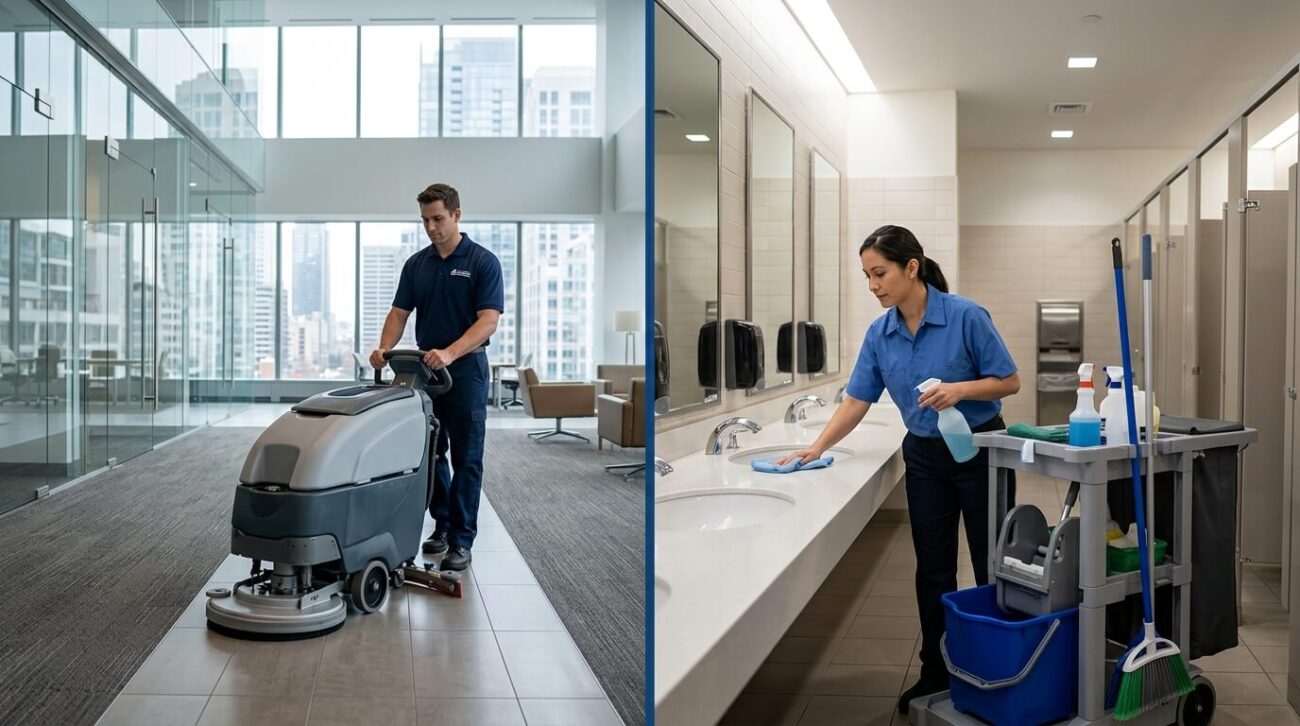
This is where the equipment gets bigger and the work gets more technical — floor scrubbers, carpet extractors, pressure washers — the kind of machinery that doesn’t make sense to run every week but makes a visible difference every quarter. Commercial cleaning is what keeps flooring, carpet, and finishes from wearing out years ahead of schedule.
Side-by-Side: Where They Actually Diverge
| Janitorial Cleaning | Commercial Cleaning | |
| Core purpose | Maintains daily cleanliness | Restores and deep-cleans periodically |
| Typical frequency | Daily to weekly | Monthly to annually, or as needed |
| Scope | Recurring, predictable tasks | Specialized, project-based work |
| Equipment | Standard vacuums, mops, disinfectants | Floor scrubbers, extractors, pressure washers |
| Best fit for | Ongoing upkeep of a functioning space | Periodic restoration and deep sanitization |
The clearest way to separate the two: janitorial cleaning is about not falling behind. Commercial cleaning is about catching up on the things that accumulate no matter how well you keep up day to day — because dust in an HVAC vent or grime in grout lines doesn’t respond to daily wiping. It needs the equipment and time a commercial job provides.
Why the Line Gets Blurry
Part of the confusion is that both services sometimes overlap in language, even when they don’t overlap in practice. “Deep cleaning” gets used by both janitorial companies advertising a more thorough weekly visit and commercial cleaning companies describing a quarterly restoration project — and those are two very different services wearing the same name.
Some cleaning companies also offer both under one roof, which blurs the distinction further from the client’s side. That’s not necessarily a problem — combining vendors is often the right move — but it means asking specifically what’s included rather than assuming “commercial cleaning services” on a website covers both daily maintenance and periodic floor care. A lot of NYC businesses have found out the hard way that their monthly invoice covered trash and vacuuming, and nothing closer to a carpet extraction.
Which One Does Your Business Actually Need?
If your space is already in decent shape and just needs upkeep — most offices, small retail stores, and professional practices fall here — janitorial cleaning is the right foundation. Recurring visits keep restrooms sanitary, floors presentable, and shared spaces from accumulating the kind of mess that becomes a bigger job later.
If your space has visible wear — stained carpet, dull flooring, grimy grout, a lobby that hasn’t seen a real deep clean since the last tenant moved out — commercial cleaning is what actually fixes it. No amount of weekly vacuuming restores carpet that’s overdue for extraction, and no daily mopping strips built-up wax from a hard floor.
If you’re opening a new space, wrapping up a renovation, or handling a tenant turnover, you need commercial cleaning first, before any recurring janitorial schedule starts. Post-construction dust and debris are a different job entirely from ongoing maintenance, and starting a janitorial contract on top of unaddressed construction grime just means paying to maintain a mess instead of clearing it out.
Most established businesses land on both — janitorial cleaning running weekly or daily, with commercial cleaning scheduled quarterly or annually to handle what routine visits can’t. Treating it as an either/or question usually means one side of the building’s upkeep gets neglected.
What This Looks Like for Different NYC Businesses
Office spaces typically run daily or several-times-weekly janitorial service for restrooms, kitchens, and common areas, with quarterly commercial cleaning for carpets and windows. A Midtown office with client meetings will lean more heavily on daily janitorial coverage than a back-office space with no visitor traffic.
Retail stores need janitorial attention daily given constant foot traffic through entrances and fitting rooms, paired with commercial floor care on a schedule tied to how much wear the storefront sees — a busy SoHo storefront wears differently than a quiet showroom by appointment only.
Medical and dental offices require janitorial-level disinfection multiple times a day in patient-facing areas, on top of commercial-level deep sanitization on a more structured schedule tied to health compliance standards, not just appearance.
Restaurants blend both constantly — daily janitorial work in dining rooms and prep areas is non-negotiable for health code compliance, while commercial cleaning handles grease trap areas, deep kitchen equipment cleaning, and floor restoration that a nightly mop-down can’t touch.
Warehouses and industrial spaces often need less frequent janitorial visits but heavier-duty commercial cleaning, since dust and debris accumulate differently in these environments than in a carpeted office.
How Staffing and Training Differ Between the Two
The people showing up for a janitorial visit and the crew handling a commercial floor restoration aren’t always the same team, and that’s by design. Janitorial staff are trained for consistency and speed across recurring tasks — the same restroom, the same trash routine, the same kitchen wipe-down, night after night. The value they bring is reliability: the same standard, delivered on the same schedule, without needing supervision every visit.
Commercial cleaning crews are trained differently, often certified on specific equipment — carpet extractors, floor buffers, pressure washers — and typically work in smaller, more specialized teams for a defined project rather than a recurring route. A janitorial cleaner showing up nightly to empty trash doesn’t necessarily have the training or equipment to run a floor stripping and waxing job, and a commercial floor crew isn’t the right fit for daily restroom upkeep.
This is worth asking about directly when vetting a vendor. A company that treats both as interchangeable — sending the same generalist crew to handle a nightly office clean and a quarterly carpet extraction — is more likely to cut corners on one or the other, since the two jobs genuinely call for different skills and equipment.
NYC-Specific Logistics That Complicate Both Services
Scheduling either type of cleaning in New York comes with building-specific wrinkles that don’t show up in a generic national guide. Freight elevator access is often restricted to certain hours, which matters far more for commercial cleaning crews hauling floor equipment than for a janitorial team carrying a vacuum and a cart. Building supers frequently require advance notice and certificates of insurance before any vendor — janitorial or commercial — gets building access after hours, and that paperwork needs lead time, especially for a one-time commercial job that isn’t already on file with the building.
Older buildings also complicate commercial cleaning specifically: original hardwood or marble flooring, aging HVAC systems, and non-standard layouts each demand a slightly different approach than a newer, more standardized commercial space. A floor stripping job in a prewar building isn’t automatically the same process as one in a 2020s Class A tower, and a commercial cleaning company unfamiliar with older NYC building stock can end up using the wrong products or techniques on original finishes.
None of this affects the fundamental distinction between janitorial and commercial cleaning, but it does mean the logistics of scheduling either one in this city take more coordination than a business in a suburban office park would ever need to think about.
Signs You’ve Outgrown Janitorial-Only Coverage
A lot of businesses start with janitorial service alone and don’t add commercial cleaning until something forces the issue — usually a client comment, a lease renewal walkthrough, or simply someone finally looking closely at the carpet under harsh afternoon light. A few signs it’s time to add commercial cleaning to the mix:
- Carpet or upholstery holds visible stains that don’t lift with regular vacuuming
- Hard floors look dull or streaked no matter how often they’re mopped
- Grout lines have darkened noticeably from their original color
- Windows haven’t had a proper interior and exterior cleaning in over a year
- Vents and light fixtures show visible dust buildup during a walkthrough
- The building or a new lease requires a documented deep-clean or restoration before turnover
None of these are janitorial failures — they’re simply outside what recurring maintenance is built to handle. Recognizing the signal early means scheduling commercial cleaning as a planned project instead of an emergency fix once a client or landlord points it out first.
Budgeting for Both Without Getting Surprised
The two services behave differently on a budget, and treating them the same way is where a lot of businesses get tripped up. Janitorial cleaning is a predictable, recurring line item — the same scope, roughly the same cost, month over month. Commercial cleaning is more like a periodic capital expense: bigger individual invoices, spaced out, tied to specific projects rather than a flat monthly rate.
Building both into a plan means separating them clearly rather than lumping “cleaning” into one number. A janitorial contract should be stable enough to forecast a year out. Commercial cleaning is better scheduled in advance — quarterly floor care, an annual window cleaning — so it shows up as an expected cost rather than a surprise invoice when someone finally notices the carpet looks tired.
Questions to Ask Before Signing With Either
Before committing to a vendor for either service, a few questions tend to surface exactly what you’re getting:
- Is this quote for recurring maintenance, a periodic deep clean, or both?
- What equipment is included, and is it brought on every visit or only for scheduled deep cleans?
- How is frequency determined — a fixed schedule, or based on an assessment of the space?
- Are staff trained and insured for the specific type of work being quoted (this matters more for commercial-scale equipment)?
- If combining both services with one vendor, is there a separate line item for each, or one bundled rate that makes it hard to see what you’re actually paying for which service?
A vendor that can answer these clearly, without vague language, is usually the one that understands the distinction well enough to actually deliver on it.
The Cost of Getting This Wrong
Businesses that hire janitorial-only coverage and expect commercial-level results are usually the ones surprised when their carpet needs replacing years ahead of schedule, or their windows haven’t been properly cleaned since the lease started. On the flip side, businesses paying commercial-cleaning rates for what amounts to a weekly trash-and-vacuum visit are overpaying for a service level they’re not actually receiving.
Getting this right isn’t complicated once the distinction is clear — it just requires being specific about which problem you’re solving. A messy break room by Thursday is a janitorial problem. Carpet that hasn’t looked right in over a year is a commercial cleaning problem. Most NYC businesses, once they see the split laid out, realize they need a light version of both rather than a heavy version of just one.
Building a Combined Plan That Actually Works
The businesses that get the most out of both services tend to treat them as one coordinated plan rather than two separate vendor relationships managed independently. That means:
- Setting janitorial frequency based on actual foot traffic and headcount, not a generic default
- Scheduling commercial cleaning in advance around slow periods, rather than reactively once something looks visibly worn
- Reviewing the split annually, since a business that’s grown from 15 to 50 employees, or moved into double the square footage, needs a different balance of both services than it did a year earlier
- Keeping communication with whichever vendor handles either service specific — flagging exactly which areas need more attention rather than a general “clean the office” instruction
A well-run NYC business doesn’t think in terms of “janitorial or commercial.” It thinks in terms of what the space needs this week versus what it needs this quarter — and builds a cleaning plan around both answers instead of picking one and hoping it covers the other.
That shift in thinking — from “which service do we need” to “what does our space need on which timeline” — is usually the point where cleaning stops being a recurring headache and starts being a plan someone actually trusts to run in the background. Once janitorial and commercial cleaning are both scheduled with intention instead of one being an afterthought, the difference between the two stops mattering day to day. It just works.
Tired of Dealing With This Yourself?
Let our NYC pros handle it — fast, thorough, done right the first time.
Book a Cleaning