
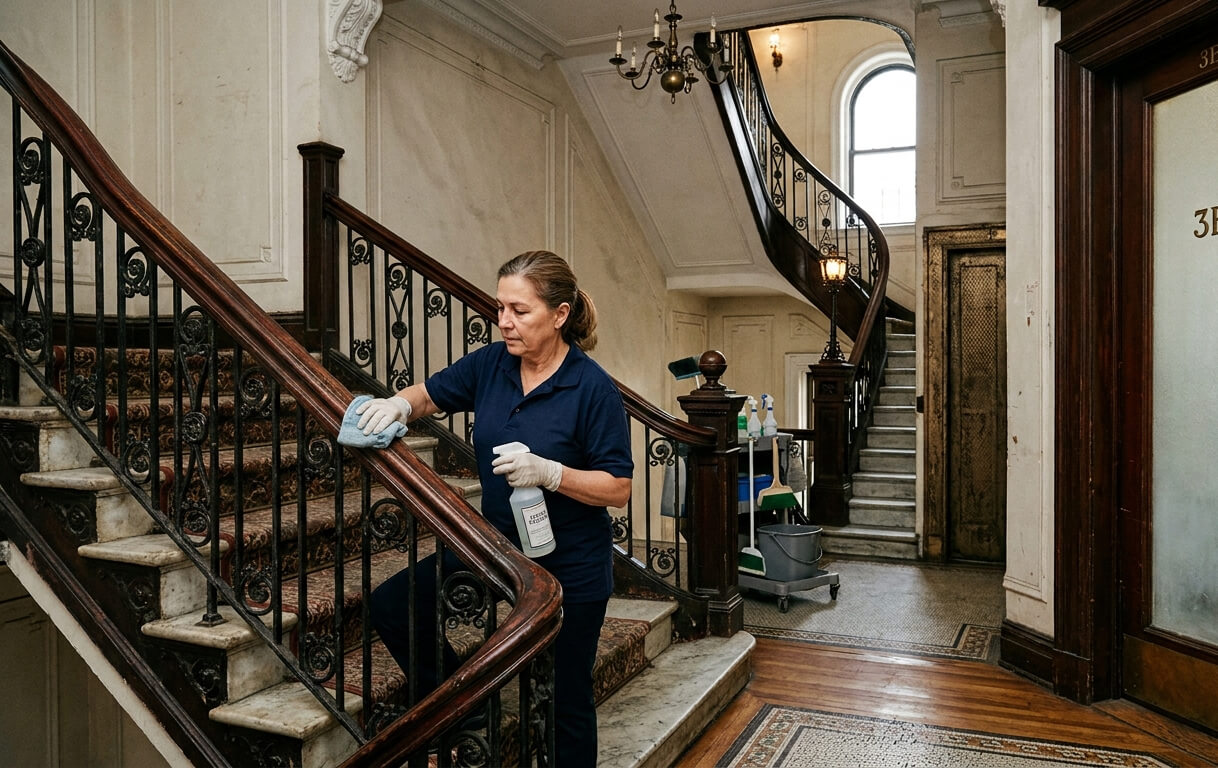
Some apartments feel new. Others feel experienced. A pre-war apartment doesn’t simply provide a place to live. It arrives carrying stories. Thick walls. Original hardwood floors. Ornate moldings. Doors that have opened and closed for generations. Radiators that occasionally communicate through mysterious clanks and hisses at three in the morning as if they’re discussing city politics with the pipes downstairs.
Pre-war buildings have personality. A lot of personality. Sometimes enough personality for several apartments. That’s exactly why pre-war apartment cleaning differs from cleaning a modern high-rise built last year. New construction generally favors smooth surfaces, simple layouts, hidden systems, and materials designed for easy maintenance. Older buildings were created during a completely different era. The craftsmanship is beautiful. The details are wonderful.
The cleaning challenges? Also wonderful, in their own peculiar way. Dust behaves differently. Air moves differently. Storage spaces appear where nobody expects them and disappear where you’d really like them to exist. Tiny architectural details that make a room feel elegant also create hundreds of small places where grime quietly settles year after year.
It’s not a flaw. It’s simply age doing what age does. A century-old building asks for a different relationship with cleaning. Not harder, necessarily. Just more thoughtful. The apartment has survived one hundred years — it deserves a little respect.
Plaster, Radiators and Original Moldings — What They Need That Newer Builds Don’t
Walk into a modern apartment and many surfaces are straightforward. Drywall. Simple trim. Minimal decorative features. Everything feels streamlined. Pre-war apartments tend to have different ambitions.
A wall might contain original plaster dating back decades. The ceiling may feature decorative medallions. Window casings can include layers of craftsmanship rarely found in contemporary construction. Radiators occupy corners like permanent residents who arrived long before anyone currently paying rent.
Wonderful features. Not always simple to maintain.
Plaster Walls Behave Differently
Plaster has a character all its own. It ages differently than drywall. It expands and contracts in slightly different ways. Tiny cracks may appear over time. Textures vary from room to room. Most importantly, plaster doesn’t particularly enjoy aggressive cleaning.
Heavy scrubbing can damage painted surfaces, especially on older walls where multiple generations of paint layers have accumulated. Gentle dusting and careful spot cleaning usually produce better results than approaching the wall as though it personally offended you.
Sometimes restraint is the most effective cleaning tool.
Original Moldings Collect More Than Admiration
Decorative crown moldings are wonderful. Until you decide to clean them. Then you discover every elegant curve has quietly collected dust for months. Perhaps years.
Intricate architectural details create countless tiny ledges where airborne particles settle. Ceiling corners become natural gathering points for dust. Decorative trim around doors and windows often holds more debris than homeowners realize.
The irony is almost charming. The same craftsmanship people love most frequently creates the areas requiring the most patience. A feather duster alone often isn’t enough. Microfiber cloths usually perform much better because they actually capture particles instead of relocating them temporarily.
Radiators Have Their Own Ecosystem
Anyone familiar with brownstone cleaning NYC projects already knows where this conversation is heading. Radiators. Those magnificent iron monuments to winter survival. Radiators collect dust with astonishing efficiency.
Inside the fins. Behind the pipes. Beneath the unit. Around valves. Places vacuum attachments seem to regard as personal challenges. Then heating season arrives. Warm air begins circulating. The accumulated dust joins the journey. Suddenly the apartment smells faintly like heated dust and old books. Not necessarily unpleasant. Just familiar.
Regular radiator cleaning reduces airborne dust while helping the system operate more efficiently. Plus, discovering what’s been hiding behind a radiator for two years can be unexpectedly entertaining. Coins. Pet toys. One earring. An entire civilization of things lost in time.
Original Woodwork Deserves Specialized Care
Many older apartments contain hardwood details impossible to replace easily. Original doors. Built-in shelving. Window casings. Decorative trim. These surfaces often respond poorly to harsh cleaners designed for modern synthetic materials.
Wood appreciates gentler treatment. Think maintenance rather than attack. Cleaning products should remove grime without stripping finishes or leaving excessive moisture behind. Old wood has survived decades. The goal is helping it survive several more.
Older Floors Carry History
Sometimes literally. Century-old hardwood floors tell stories through wear patterns. The path between kitchen and dining room. The area near a favorite window. Places where generations walked thousands upon thousands of times.
Cleaning these floors requires understanding that older finishes may differ from modern polyurethane coatings. Aggressive products occasionally create more problems than they solve. Age deserves consideration. Not pity — just consideration.
Tall Ceilings Change Everything
Many pre-war apartments feature ceilings far higher than contemporary construction.
Wonderful for natural light. Wonderful for airflow. Wonderful for dust accumulation too. Warm air rises. Dust follows.
Ceiling moldings, light fixtures, upper shelves, and decorative features become collection points that residents rarely inspect closely. Out of sight has always been dust’s favorite strategy.
Built-Ins Create Hidden Zones
Older apartments frequently contain niches, cabinets, alcoves, and built-in storage features. They add charm. They also create corners. Many corners. Dust rarely complains about additional corners.
Bookshelves deserve special mention. Particularly older built-ins. Books collect dust. Shelves collect dust. The spaces behind books collect dust. The dust itself occasionally seems to collect dust. An impressive level of dedication.
Window Areas Work Overtime
Original windows often contain more architectural detail than modern counterparts. Extra trim. Deep sills. Decorative casings. Weight pockets hidden inside wall cavities. The result is more surface area for dust, pollen, and city grime.
Open windows during spring and the apartment happily welcomes fresh air. Fresh air arrives carrying friends. Pollen. Soot.Street dust. Tiny particles with long-term housing ambitions.
Closets Hide More Than Clothing
Pre-war closets can be wonderfully unpredictable. Some are surprisingly deep. Some contain odd shelves added decades ago. Others seem to occupy dimensions unavailable to modern architecture. Dust loves all of them.
Closet floors often become overlooked storage zones where dirt accumulates gradually over years because nobody looks closely enough to notice. Until moving day. Moving day reveals everything. Always.
Under Radiators and Appliances
These areas deserve their own category. Not because they’re unusual — because they’re consistently ignored.
Dust gathers beneath radiators faster than most people realize. Kitchen appliances collect grease particles mixed with ordinary dust. Air circulation pushes debris into places rarely reached during everyday cleaning.
The buildup happens slowly. Which is precisely why it becomes significant.
Old Airflow Patterns
Older buildings breathe differently. Cracks around windows. Original ventilation paths. Steam heat systems. Seasonal airflow changes. All influence where dust settles. Understanding those patterns helps explain why certain rooms become dusty much faster than others.
The dust isn’t random. It has preferences. Annoyingly sophisticated preferences.
How a Cleaning Approach Should Adapt to an Older Building
The biggest mistake people make with older apartments? Treating them exactly like new construction.
The apartment notices. Immediately.
Cleaning Should Be More Deliberate
Older homes reward patience. A quick wipe-down might handle visible surfaces, but meaningful cleaning often requires attention to architectural details newer apartments simply don’t possess. Window trim. Moldings.Radiators. Built-ins. Original woodwork.
Small features add up quickly. That’s where much of the character lives. And much of the dust.
Dusting Becomes More Important Than People Expect
Vacuuming floors matters. Of course. But in older buildings, dusting often becomes equally important because so much dust settles above eye level. High shelves. Ceiling trim. Light fixtures. Decorative details. Ignoring those areas creates a cycle where particles continuously drift back into living spaces.
Gravity remains committed to its work.
Gentle Products Usually Win
Strong chemicals create a certain psychological satisfaction. Everything smells aggressively clean. Unfortunately, older materials sometimes disagree.
Gentler products often protect finishes better while still removing dirt effectively. The goal isn’t overpowering every surface. The goal is preserving it.
Frequency Matters More Than Intensity
An apartment cleaned regularly often requires less aggressive intervention. Dust never develops into layers. Grime never hardens into permanent residents. Maintenance remains manageable. This becomes especially valuable in older buildings because delicate materials generally respond better to consistent care than occasional deep assaults.
Think gardening. Not excavation.
Professional Cleaning Can Be Surprisingly Helpful
Not because residents can’t clean their own apartments. Most certainly can. But experienced teams familiar with pre-war apartment cleaning understand the peculiarities of older buildings.
They know where old building dust tends to accumulate. They understand how to clean original woodwork, plaster, radiators, and architectural details without causing unintended damage.
Experience removes guesswork. That’s often worth more than people expect.
Every Building Develops Its Own Personality
One brownstone accumulates dust near original windows. Another gathers it around radiator systems. A third seems permanently involved in a quiet battle with pollen every spring. Buildings age differently. Cleaning routines eventually adapt accordingly.
The apartment teaches you. If you’re paying attention. Living in a pre-war apartment means inheriting more than square footage. You inherit craftsmanship. History. Architectural details that survived decades of changing tastes, renovations, and city life. Those details create beauty, but they also influence how cleaning should happen.
Effective pre-war apartment cleaning isn’t about forcing a century-old space to behave like a modern condo. It’s about understanding what makes the apartment different and adjusting accordingly. Original moldings require attention newer apartments don’t need. Radiators gather dust in places central air systems never would. Tall ceilings and built-ins create opportunities for accumulation that remain invisible until sunlight suddenly reveals them one afternoon.
That’s why brownstone cleaning NYC projects often focus as much on architectural features as ordinary household surfaces. The details matter. They always have. And then there’s the dust. The legendary old building dust that seems capable of appearing moments after you’ve finished cleaning. Part of that is airflow. Part of it is age. Part of it might simply be New York refusing to make anything too easy. Fair enough.
A hundred-year-old building wasn’t designed to be effortless. It was designed to last. Cleaning it well means working with that history instead of against it. The apartment has already proven its durability — you’re mostly helping it continue the conversation.
Skip the Cleaning. Keep the Weekend.
Book your cleaning in 60 seconds — we handle the rest.
Book Now