Hardwood is one of the few things in a New York apartment that gets better when you leave it alone and worse when you try too hard. Most of the damage we hear about does not come from neglect. It comes from enthusiasm: a soaking mop, a bottle of vinegar from the pantry, a steam cleaner bought in a sale, an all-purpose spray that was on the shelf. Each one feels like a reasonable thing to do on a Saturday morning, and each one does a little harm to the finish that protects the wood.
The National Wood Flooring Association, the trade body for the industry, has said in its own consumer research that only about one in four homeowners knows the correct way to clean a wood floor. Hardwood Floors magazine, in a piece summarizing the association’s guidelines, adds that much of the guidance online is simply wrong, and lists baking soda, essential oils and a bucket of water among the popular suggestions that cause serious trouble. If you have ever stood in a hardware store aisle unsure which of twelve bottles to buy, you are in good company.
This guide covers solid and finished hardwood floors, the kind that run through many older New York apartments and plenty of renovated ones. It explains what the floor is protected by, which tools and cleaners are safe, how to clean it step by step, how often, and what the city adds to the picture: grit tracked in from the street, radiator heat, dry winters and furniture that never stays put in a small room. If your floor is engineered wood, laminate or vinyl plank, those floors follow different rules, and our guide to engineered hardwood, laminate and vinyl plank is the better starting point.
Know What You Are Cleaning
Most finished hardwood floors today carry a clear protective coating, usually polyurethane, over the wood. That coating does the work of keeping out water and resisting scratches. When people say a floor is dull or damaged, they usually mean the coating is worn, not the wood itself. Cleaning a hardwood floor is really about protecting that coating so it lasts as long as possible.
This is why the advice on cleaning wood floors keeps returning to the same few ideas: use as little water as you can, avoid products that leave residue or strip the finish, and remove grit before it grinds into the surface. NBC Select’s guide, which draws on professional advice, makes the point bluntly in an expert’s words that water and hardwood floors do not get along. The Hardwood Floors magazine summary of the association’s guidelines is just as direct: do not wet-mop a wood floor, because standing water can cause cracks, splits, cupping, warping and damage to the finish.
Before you buy any product, find out what is on your floor and what the manufacturer or installer recommends. Tom’s Guide advises using a hard floor cleaner as the manufacturer recommends, and the association guidance notes that improper products can void manufacturer and labor warranties and can cause adhesion problems with future maintenance coats, which is the coating a refinisher applies to renew the surface. In a rental, that means asking the landlord or management office what the floor is and whether there are care instructions on file. In a condo or co-op, the building’s documents sometimes name the product.
If you cannot find out, treat the floor as finished hardwood with a modern coating and use the gentlest methods in this guide. They are safe for nearly every finished wood floor.
The Tools That Actually Help
You do not need much, and the tools matter less than the habit of using them regularly.
A microfiber dust mop or a soft broom picks up dry dirt without scratching. Tom’s Guide lists both as the first choice for everyday cleaning.
A vacuum is the other core tool, with a condition. Use one that has a setting for hard floors, and turn off the beater bar or brush roll if it has one. The association guidance says to use only vacuum cleaners with a hard surface setting and to switch off the beater bar. Tom’s Guide gives the same advice in other words: use the hard floor setting, or raise the brush bar, and look for rubber wheels, which will not scuff the floor. A rotating bristle brush dragged across a finish does the same thing as sandpaper, only slower.
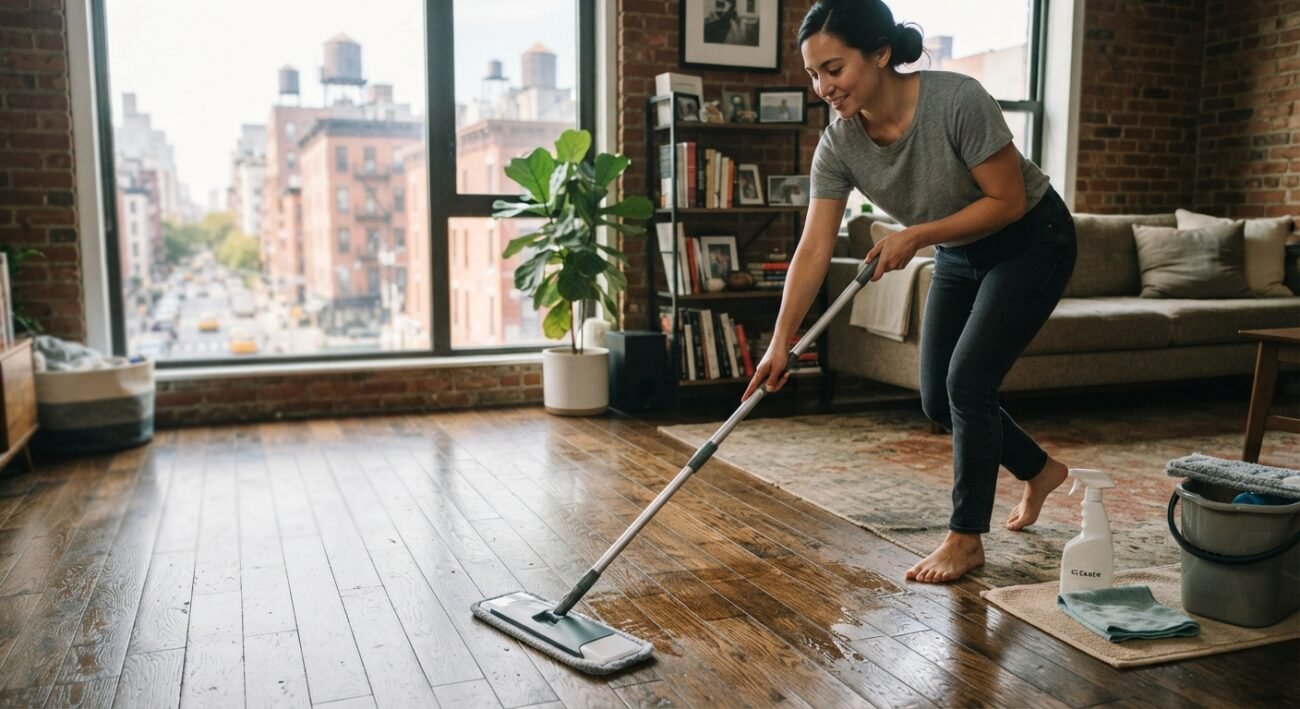
For damp cleaning, a spray mop or a well wrung microfiber mop gives you control over how much moisture reaches the floor. NBC Select recommends a spray mop or a well wrung spin mop, with no puddles, and letting the floor dry on its own. A bucket and a dripping string mop are the wrong tool for a wood floor, particularly in a small apartment where there is nowhere for the water to go.
For cleaner, use a product made for finished hardwood, and follow the dilution on the label. NBC Select’s experts warn that all-purpose household cleaners, the kind sold for every surface, can damage a wood floor over time, so a general spray from under the sink is not a substitute. Tom’s Guide says to follow the manufacturer’s recommendation for a hard floor cleaner and to test any home remedy first.
How to Clean a Hardwood Floor, Step by Step
This routine works on most finished hardwood floors. It takes about as long as mopping any other floor, and it is gentler on the surface.
Step 1: Remove the grit
Start dry. Sweep with a soft broom, run a microfiber dust mop over the floor, or vacuum with the hard floor setting and the brush roll off. NBC Select describes the order in the same way: dust or sweep first, then vacuum, then damp mop. Pay attention to the edges along the baseboards and the spaces under furniture and radiators, where dust gathers and where a mop rarely reaches.
The reason to begin with this step is that most floor damage is abrasive. A damp mop dragged across a floor that still has grit on it pushes the grit around and scratches the finish. Doing the dry pass thoroughly means the damp pass only has to deal with film and spills.
Step 2: Deal with spots first
Wipe spills as soon as they happen. The association guidance lists this first among its maintenance rules, and it is the single most effective habit. For a dried splash, such as cooking splatter near the stove, use a barely damp cloth rather than a bigger mop, and dry the spot right away.
Step 3: Damp mop, lightly
Mist a spray mop pad, or wring a microfiber pad until it feels barely wet, and mop with the grain of the boards. Work in sections and do not let moisture sit on the surface. The floor should look slightly damp for a moment and then dry. If you see standing water, or a floor that stays wet for several minutes, you are using too much.
Tom’s Guide gives the same standard in its own way: use a damp mop, not a wet one, because water by itself can swell and discolor the wood. NBC Select adds that even sealed floors should not be drenched.
Step 4: Let it dry quickly
Moisture is the risk, and ventilation helps. Tom’s Guide suggests drying quickly with ventilation, a fan, or a dry cloth, and NBC Select says to let the floor dry on its own after you finish with a lightly damp mop. In a small apartment, opening a window or switching on a fan for ten minutes is easy to do, and walking on the floor in socks while it is still damp invites water marks and footprints.
Step 5: Put the furniture back carefully
Lift, do not drag. The association guidance says not to slide heavy furniture across a wood floor and to pick it up completely where possible, and to use safety glides when moving appliances. A floor that is clean and dry is also the floor most easily scratched by a chair leg.
What Not to Use on a Hardwood Floor
The list of things to avoid is short, and each item is the answer to a question people ask often.
Water in quantity is the main enemy. A mop that is dripping, a bucket of water, and any method that leaves puddles can cause swelling, cupping and damage to the finish over time. If a spill reaches the floor, wipe it up at once.
Steam cleaners are on the list because they combine heat and moisture. The association guidance states that steam cleaners should not be used on wood floors, because water in vapor form penetrates the wood fibers and can cause irreversible damage to the wood and the finish. Tom’s Guide takes a slightly more cautious line, saying not to use a steam cleaner unless the manufacturer of your floor advises it. Either way, unless the maker of your floor has said yes in writing, the answer is no.
Vinegar is the most common home remedy and the one most often misused. Tom’s Guide tells readers to test vinegar before using it and notes that it can dull a finish. Because the coating is the part you are protecting, a product that wears away at the coating a little with each use is not a bargain, even if the first cleaning looks fine.
Baking soda, essential oils and homemade mixtures belong in the same category. The magazine’s list of widely shared but problematic suggestions includes baking soda and essential oils. A cleaner designed for finished hardwood is formulated to clean without leaving residue or attacking the coating. A homemade mix has no such design behind it.
All-purpose cleaners, including the familiar scented floor products, are also on the list. NBC Select’s experts say that multipurpose cleaners can damage hardwood over time, even if they seem to work at first. The damage is cumulative, which is why it takes months to notice.
Wax and polish are a quieter problem. Tom’s Guide says to apply wax or polish only every few years, and never on laminate or engineered flooring. Many modern floors do not need wax, and adding a coating over a finish that was not meant to take it can cloud the surface. If your floor is the older, waxed type, ask a flooring professional before you do anything yourself.
Abrasive pads, steel wool and stiff brushes scratch a finish the way sandpaper does. A soft microfiber pad is as rough as you should go.
How Often to Clean
The right frequency depends on traffic, and a one-bedroom with two people and a dog is not the same as a studio with one person who travels. The guidance from the sources gives a useful range.
| Task | Typical frequency |
| Dust mop or sweep | A couple of times a week in high traffic areas |
| Vacuum with hard floor setting | Weekly |
| Damp mop | About monthly, or every three to four weeks |
| Wipe spills | Immediately |
| Wax or polish | Only every few years |
Tom’s Guide suggests dusting a couple of times a week in busy areas, vacuuming weekly and mopping every three to four weeks, and NBC Select gives a similar pattern of weekly sweeping or vacuuming and a damp mop monthly. The consistent message is that the dry pass is the frequent task and the wet pass is the occasional one. A floor that looks dull between mops usually needs more dry cleaning, not more water.
When the Floor Has Lost Its Shine
Sometimes a floor looks tired even when it is clean. The finish itself is worn, particularly along hallways, in front of the kitchen sink and under a desk chair. The association guidance says that when a floor loses its luster, it is time for a recoat. A recoat, also called a maintenance coat, is a new layer of finish applied over a properly prepared existing one, and it is different from sanding and refinishing, which takes the surface down to bare wood.
A recoat or refinish is a job for a flooring contractor, not for a cleaner or a bottle of polish. Our work is cleaning: the dirt, film and residue that sit on top of the finish. We do not sand, recoat or refinish floors, and if yours has reached that stage, a flooring specialist is who you want. What a good cleaning routine does is delay that day. The association’s guidance notes that most floors will need a maintenance coat at some point depending on traffic, so the goal is spacing the work out, not avoiding it.
What Makes New York Different
A floor in a New York apartment faces a few things that a floor in a larger home often does not.
Grit from the street
Everything tracked in from the sidewalk ends up at your door: sand, salt, gravel and moisture. The association recommends breathable throw rugs both inside and outside the doorways to keep grit, salt, chemicals, sand and moisture off the floor, which reduces scratching and premature wear. In a small apartment the front door is often the only entrance and the floor beside it takes the worst of it, so a mat there does more for the whole floor than any cleaner. Shoes off at the door does even more, and a tray or mat for wet boots in winter keeps salt from leaving white marks.
If you use non-skid pads under area rugs, check them. The association warns that some non-skid pads can imprint their pattern onto the finish or the wood, and that natural fibers tend to transfer less than some synthetic ones. Rugs also protect the floor beneath from sunlight, which means the wood under a rug will stay a different color from the wood around it if the rug stays in place for years. That is not damage, but it surprises people when they move the rug.
Radiators, heat and dry air
Heating season changes a New York apartment’s air. Steam radiators and forced air heat dry out the rooms, and wood responds to humidity by shrinking and expanding. The association guidance advises using a humidifier in the winter or dry months, and a dehumidifier in the wet months, to keep wood movement to a minimum, and says that humidification helps avoid complaints about gaps between boards in dry seasons. In practice that means a small humidifier in the living room in January. The gaps that open in winter and close in summer are normal, but a big swing makes them wider.
Furniture, chairs and heels
In a small apartment the furniture moves more often than in a large house, because the layout has to change to fit guests, a desk or a bed. Fabric-faced glides under the legs of chairs and tables protect the finish, and the association suggests checking them periodically for embedded soil and replacing them as needed. Rolling chairs and carts are the worst offenders, and a chair mat made for hardwood goes a long way.
The same guidance cautions against walking on wood floors in cleats, sports shoes or high heels, and gives a figure that explains why: a 125 pound person in high heels exerts an impact of about 2,000 pounds per square inch, and an exposed heel nail can reach 8,000. Keeping pet claws trimmed is the other half of that advice.
Rentals
If you rent, the floor is the landlord’s property and you are responsible for returning it in reasonable condition. Photograph the floor when you move in, and use only products that are safe for the finish. The association’s note that improper products can void warranties is a good reason to ask before you try anything unusual.
Quick Fixes for Common Problems
Dullness after mopping is usually residue, from too much cleaner or the wrong one. Go over the floor with a barely damp microfiber pad and plain water, then dry, and switch to a hardwood cleaner used sparingly.
A sticky patch near the stove is cooking grease. Wipe it with a cloth wrung almost dry, with a drop of dish soap if needed, then wipe again with a clean damp cloth and dry the spot.
White marks near the door in winter are salt. Wipe with a damp cloth, dry quickly and add a mat.
Scuffs from shoes or furniture often lift with a dry or barely damp microfiber cloth. Do not scrub with an abrasive pad.
A water spill that sat is more serious. Dry it immediately, run a fan, and if the boards begin to raise or darken, call a flooring professional rather than waiting.
When a Professional Cleaner Helps
Most of the hardwood routine is light work that you can do in twenty minutes a week. What makes it hard in practice is the schedule: the dry passes, the corners and the spots behind furniture are the things that slip when work, travel and a small apartment take over.
That is where regular help fits. Our standard cleaning visits include vacuuming and mopping hard surface floors on every visit, room by room, including corners, edges and under accessible furniture, so the dry pass that matters most is done weekly or every other week. If you have hardwood, tell us when you book and mention the finish, so we know what to use and what to leave alone. The floor surface itself, meaning sanding, recoating or refinishing, remains a flooring contractor’s job.
For a home that has gone a while without attention, a one time deep cleaning is a useful reset, since it deals with the buildup around baseboards, behind furniture and in the corners where a regular mop does not reach. Our deep cleaning service is built for that kind of reset, and regular visits then keep it that way.
Tired of Dealing With This Yourself?
Let our NYC pros handle it — fast, thorough, done right the first time.
Book a Cleaning